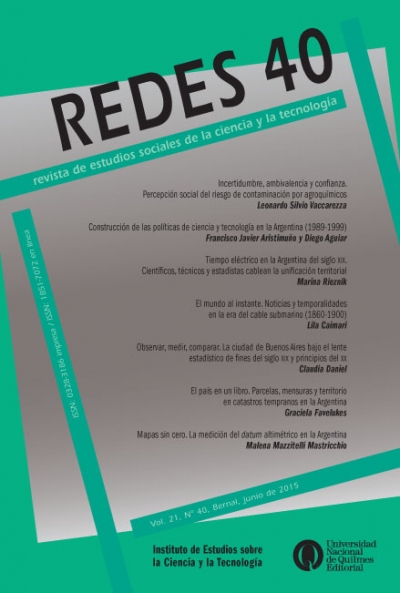
Incertidumbre, ambivalencia y confianza. Percepción social del riesgo de contaminación por agroquímicos.
DOI:
https://doi.org/10.48160/18517072re40.601Palavras-chave:
riesgo, incertidumbre, ambivalencia, tecnología agrícolaResumo
El desarrollo de la tecnociencia ha impactado en la percepción social pública de la tecnología y dio lugar al desarrollo de conceptos específicos: riesgo, percepción y aceptabilidad del riesgo, incertidumbre, ambivalencia, confianza en la ciencia. En el presente artículo se analizan los efectos en la salud y en el medio ambiente por la expansión del cultivo de la soja en la Argentina y por el uso del agroquímico glifosato –un tema publicitado en los medios masivos de comunicación–, como ejemplo adecuado para explorar las relaciones entre esos conceptos, con base en información de una encuesta realizada a estudiantes universitarios. Se observó una relativa independencia entre los indicadores de los conceptos mencionados, de manera tal que es posible sugerir que las actitudes y representaciones sociales de este público acerca de la ciencia y la tecnología expresan posiciones ambiguas. Se trabaja empíricamente una distinción con respecto al concepto de incertidumbre que recoge sendas corrientes teóricas: una que la define como insuficiencia en el conocimiento, y otra que enfatiza los aspectos emocionales de la falta de certeza. La incertidumbre cognitiva y la percepción del riesgo son relativamente independientes de la ambivalencia; esto es, la coexistencia de valores contradictorios con respecto a la tecnología en el mismo sujeto, y que la confianza en los científicos y tecnólogos no deriva de la asignación de ignorancia, sino de la imagen de aquellos como motivados por intereses contradictorios con las normas morales vinculadas al conocimiento.
Referências
Bárcena, A. et al. (eds.) (2004), Los transgénicos en América Latina y el Caribe: un debate abierto, Santiago de Chile, cepal.
Bauman, Z. (1991), Modernity and Ambivalence, Oxford, Polity Press-Blackwell.
Beck, U. (1992), Risk Society, Londres, Sage.
Blok, A., M. Jensen y P. Kaltoft (2008), “Social identities and risk: expert and lay imaginations on pesticide use”, Public Understanding of Science, vol. 17, N° 2, pp. 189-209.
Bravo, A. L. et al. (2010), Los señores de la soja. La agricultura transgénica en América Latina, Buenos Aires, Clacso.
Funtowicz, S. y J. Ravetz (1993), Epistemología política. Ciencia con la gente, Buenos Aires, Centro Editor de América Latina.
Giarracca, N. y M. Teubal (2005), El campo argentino en la encrucijada. Estrategias y resistencias sociales, ecos en la ciudad, Buenos Aires, Alianza.
Irwin A. y M. Michael (2003), Science, Social Theory and Public Knowledge, Maidenhead, Open University Press.
Kerr, A., S. Cunningham-Burley y R. Tutton (2007), “Shifting subject positions: experts and lay people in public dialogue”, Social Studies of Science, vol. 37, N° 3, pp. 385-410.
Luján, J. L. y O. Todt (2007), “Precaution in public: the social perception of the role of science and values in policy making”, Public Understanding of Science, vol. 16, N° 1, pp. 97-109.
Mc Cormick, S. (2007), “Democratizing Science Movements: A New Framework for Mobilization and Contestation”, Social Studies of Science, vol. 37, N° 4, pp. 609-623.
Michael, M. (1996), “Ignoring science: discourses of ignorance in the public understanding of science, en A. Irwin y B. Winner, Misunderstandig science?: The Public Reconstruction of Science and Technology, Cambridge University Press, pp. 107-125.
Pengue, W. (2000), Cultivos transgénicos. ¿Hacia dónde vamos? Algunos efectos sobre el ambiente, la sociedad y la economía de la nueva “recombinación” tecnológica, Buenos Aires, Programa de Ciencia y Tecnología para América Latina y el Caribe, Unesco.
Powell, M. et al. (2007), “Exploring lay uncertainty about an environmental health risk”, Public Understanding of Science, vol. 16, N° 3, pp. 323-343.
Priest, S. (2006), “Public discourse and scientific controversy: a spiral-of-silence. Analisys of Biothecnology opinion in United State”, Science Communication, vol. 28, N° 2, pp. 195-215.
Scott, A. y R. Du Plessis (2008), “Eliciting situated knowledges about new technologies”, Public Understanding of Science, vol. 17, N° 1, pp. 105-119.
Sztompka, P. (2006), Trust: a Sociological Theory, Cambridge, Cambridge University Press.
Torres Albero, C. (2005), “La ambivalencia ante la ciencia y la tecnología”, Revista Internacional de Sociología, N° 42, pp. 9-38.
Trigo, E. et al. (2004), Los transgénicos en la agricultura argentina, Montreal, International Institute for Sustainable Development.
Tutton, R. (2007), “Constructing participation in genetic databases: citizenship, governance and ambivalence”, Science, Technology and Human Values, vol. 32, N° 2, pp. 172-195.
Wynne, B. (1992), “Uncertainty and environmental learning”, Global Environmental Change, vol. 2, N° 2, pp. 111-127.
Yearly, S. (2000), “Making systematic sense of public discontents with expert knowledge:two analytical approaches and a case study”, Public Understanding of Science, 9, pp. 105-122.
Downloads
Publicado
Como Citar
Edição
Seção
Licença
Copyright (c) 2015 Redes. Revista de Estudios Sociales de la Ciencia y la TecnologíaOs documentos publicados aqui são regidos pelos critérios de licenciamento Creative Commons Argentina.Atribución - No Comercial - Sin Obra Derivada 2.5 https://creativecommons.org/licenses/by-nc-nd/2.5/ar/