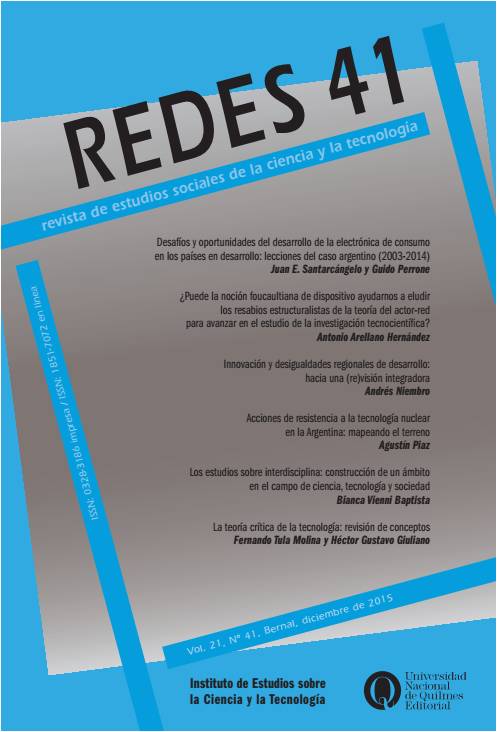
Can the Foucaultian notion of dispositif help us to escape from the structuralist vices of Actor-Network Theory in order to move forward in the study of technoscientific research?
DOI:
https://doi.org/10.48160/18517072re41.602Keywords:
actor network, dispositif, foucault, technoscientific researchAbstract
By using the concept of network, many scholars were able to express heterogeneous, relational, post-systems aspects in the description of the sociotechnical organisation; they were also able to incorporate linguistic and communicational descriptions in the relations among actors and to support with scientific and technical elements the composition of social relations. These
explanatory capabilities were organised in the movement known as Actor-Network-Theory (ant). However, after the rise of countless ant-style studies that privileged a descriptive and nomological position, the result of this was, paradoxically, the weakening of ant’s original methodological qualities. In this context, this article presents the result of our analysis of Foucault’s post-structuralist work, in order to keep alive a methodological position capable to move forward in the knowledge of technoscientific research and of knowledges and technics in general. To do this, we explore the development and use of the notion of actor-network as an organizational description of the technocientific phenomenon; then, we analyse the common criticisms towards ant. Finally, we present the epistemological capabilities of Foucault’s notion of ‘dispositif ’, this in order to help
science and technology studies to move forward favouring an analytic attitude rather than a nomological ambition.
References
Agamben, G. (2014), Qu’est-ce qu’un dispositif?, París, Collection Rivages.
Arellano Hernández, A. (1999), La producción social de los objetos técnicos agrícolas: antropología de la hibridación del maíz de los agricultores de los Valles Altos de México, Toluca, uaem.
Arellano Hernández, A. (2000), “La filosofía de Michel Serres: una moral de base objetiva”, Convergencia. Revista de Ciencias Sociales, vol. 7, Nº 23, Toluca, uaem, pp. 31-48.
Arellano Hernández, A. (2003), “La sociología de las ciencias y de las técnicas de Michel Callon y Bruno Latour”, en Ocampo Ledesma, J., E. Patlán Martínez, A. Arellano Hernández (comps.), Un debate abierto. Escuelas y corrientes sobre la tecnología, México, Universidad Autónoma de Chapingo, pp. 87-104.
Arellano Hernández, A. (2004), “Globalization de genes and social relationships: the production of the first genetically modified vegetable of commercial interest in México”, Congres Scientifiques Services 4s & easst Meeting, École de Mines de Paris, 25-28 de agosto.
Arellano Hernández, A. (2013), “¿Es posible una epistemología política que solucione la asimetría entre naturaleza absolutizada y política relativizada?”, en Beltrán López, C., Filosofía política contemporánea, México, iif-Facultad de Filosofía y Letras-unam.
Arellano Hernández, A., L. María Morales y C. Ortega (2013), “Experiencia de las investigaciones en redes sociotécnicas desde la uaem”, en Arellano Hernández, A., M. Chauvet y R. Viales (coords.), Redes y estilos de investigación: ciencia, tecnología, innovación y sociedad en México y Costa Rica, México, Porrúa-uam-uaem.
Arvanitis, R. y G. Dutrénit (1997), “La investigación tecnológica básica: ¿ciencia pública o ciencia privada?”, Revista Mexicana de Sociología, Nº 3, pp. 83-107.
Bijker, W. E., T. P. Hughes y T. Pinch (1987), The social construction of technological systems, Londres, The mit Press Cambridge.
Blau, M. P. y E. J. Schwartz (1984), Crosscutting Social Circles: Testing a Macrostructural Theory of Intergroup Relations, Orlando, Academic Press.
Borgatti, S. P. y M. G. Everett (1999), “Models of Core/Periphery Structures”, Social Networks, Nº 21, pp. 375-395.
Bourdieu, P. (1997a), Los usos sociales de la ciencia, Buenos Aires, Ediciones Nueva Visión.
Bourdieu, P. (1997b), Razones prácticas, Barcelona, Anagrama.
Burt, R. S. (1980), “Autonomy in a Social Typology”, American Journal of Sociology, Nº 85, pp. 892-925.
Bussolini, J. (2010), “What is a Dispositive”, Foucault Studies, Nº 10, pp. 85-107.
Callon, M. (1974), “L’opération de traduction comme relation symbolique”, en Roqueplo, P. (dir.), Incidence des rapports sociaux sur le développement scientifique, París, msh, pp. 105-139.
Callon, M. (1980a), “The State and Technical innovation: A case study of the electrical vehicle in France”, Research Policy, Nº 9, pp. 358-376.
Callon, M. (1980b), “Struggles and Negotiations to define what is Problematic and what is not: the Sociology of Translation”, en Knorr, K. D., R. Krohn y R. D. Whitley (eds.), The Social Process of Scientific Investigation: Sociology of the Sciences Yearbook, vol. 4, Dordrecht/Boston, D. Reidel, pp. 197-219.
Callon, M. (1981), “Pour une Sociologie des Controverses Technologiques”, Fundamenta Scientiae, vol. 2, Nº 3/4, pp. 381-399.
Callon, M. (1986a), “The sociology of an actor-network: The case of the electric vehicle”, en Callon, M., J. Law y A. Rip (eds.), Mapping the Dynamics of Science and Technology: Sociology of Science in the Real World, Londres, Macmillan, pp. 19-34.
Callon, M. (1986b), “Some elements of sociology of translation: Domestication of the scallops and fishermen of St. Brieuc Bay”, en Law, J. (ed), Power, action and belief: A new sociology of knowledge? Sociological Review Monograph, Londres, Routledge.
Callon, M. (1987), “Society in the making: The Study of Technology as a Tool for Sociological Analysis”, en Bijker, W. E., T. P. Hughes y T. Pinch, The social construction of technological systems, Londres, The mit Press Cambridge.
Callon, M. (1999), “Actor-Network Theory: the Market Test”, en Law, J. y J. Hassard (eds.), Actor Network and After, Oxford/Keele, Blackwell and the Sociological Review, pp. 181-195.
Callon, M. (2006), “Sociologie de l’acteur réseau”, en Akrich, M., M. Callon y B. Latour, Sociologie de la Traduction. Textes fondateurs, París, Presses des Mines de Paris.
Callon, M. (2016), “Mercados civilizadores: el comercio de carbono entre experimentos in vitro e in vivo”, en Arellano Hernández, A., Hacia una antropología de la atmósfera y el cambio climático, Porrúa-uaem, pp. 89-122.
Callon, M. y J. Law (1982), “On Interests and their Transformation: Enrolment and Counter-Enrolment”, Social Studies of Science, Nº 12, pp. 615-625.
Casas, R. (2001), “Espacios emergentes de conocimiento en las regiones: hacia una taxonomía”, en Casas, R. (coord.), La formación de redes de conocimiento, Barcelona, Anthropos/iis-unam, pp. 13-34.
Casas, R., M. Luna y M. J. Santos (2001), “Conclusiones generales”, en Casas, R. (coord.), La formación de redes de conocimiento, Barcelona, Anthropos/iis-unam, pp. 365-374.
Castells, M. (1996), La era de la información: economía, sociedad y cultura, vol. 1, México, Siglo XXI.
Deleuze, G. (1999), “¿Qué es un dispositivo?”, en Balbier, E. et al., Michel Foucault, filósofo, Barcelona, Gedisa, pp. 155-163.
Diderot, D. (1875-1877), “Le rêve de d’Alembert”, en Oeuvres complètes de Diderot, rev. sur les éd. originales comprenant ce qui a été publié à diverses époques et les ms. inédits conservés à la Bibliothèque de l’Ermitage par J. Assézat, t. ii, Liechtenstein, Kraus Reprint, pp. 101-191.
Foucault, M. (1975), Surveiller et punir, París, Gallimard.
Foucault, M. (1994), “Le jeux de Michel Foucault (entretien avec D. Colas, A. Grosrichard, G. le Gaufrey, J. Livi, G. Miller, J. Miller, J-A. Miller, C. Millot, G. Wajeman)”, Bulletin Périodique du Champ Freudien, Nº 10, pp. 62-93.
Foucault, M. (1999), Historia de la sexualidad 1. La voluntad de saber, México, Siglo XXI.
Freeman, C. L. (1979), “Centrality in Social Networks: Conceptual Clarification”, Social Networks, vol. 1, pp. 215-239.
Freeman, C. L. (1984), “Prometheus unbound”, Futures, vol. 16, Nº 5, pp. 494-507.
Freeman, C. L. (1991), “Networks of innovators: A synthesis of research issues”, Research Policy, Nº 20, pp. 459-514.
Giddens, A. (1994), Más allá de la izquierda y la derecha. El futuro de las políticas radicales, Madrid, Cátedra.
Granovetter, M. (1973), “The strength of weak ties”, American Journal of Sociology, vol. 78, Nº 6, p. 78.
Hughes, T. P. (1983), Networks of Power, Baltimore, The Johns Hopkins University Press.
Hughes, T. P. (1987), “The Evolution of Large Technological Systems”, en Bijker, W. E., T. P. Hughes y T. Pinch (1987), The social construction of technological systems, Londres, The mit Press Cambridge.
Jasanoff, S. et al. (1995), Handbook of Science and Technology Studies, Londres, Sage Publications.
Latour, B. (1986), “The powers of association”, en Law, J. (ed.), Power, action and belief: A new sociology of knowledge? Sociological Review Monographs, Nº 32, Londres, Routledge.
Latour, B. (1989), La science en action, París, La Découverte.
Latour, B. (1991a), “Sommes-nous postmodernes? Non, amodernes ! Étapes vers une anthropologie des sciences”, en Horton, R., La pensée métisse. Croyances africaines et rationalité occidentale, París, Cahiers de l’iued et puf, pp. 45-68.
Latour, B. (1991b), Nous n’avons jamais été modernes, París, La Découverte.
Latour, B. (1996), “On Actor-network theory, a few clarifications”, Soziale Welt. Zeitschrift fur Sozialwissenschaftliche Forschung und Praxis, vol. 47, Nº 4, pp. 369-381.
Latour, B. (1998), “La sociología de las ciencias y técnicas en todos sus estados. Conversación con Bruno Latour”, Revista Argumentos, Estudios Críticos de la Sociedad, México, uam-Xochimilco, pp. 117-127.
Latour, B. (1999), “On Recalling ant”, en Law, J. y J. Hassard (eds.), Actor Network and after, Oxford, Blackwell/The Sociological Review, pp. 15-25.
Latour, B. (2005), Reassembling the Social: An Introduction to Actor-Network-Theory, Oxford, Oxford University Press.
Latour, B. y S. Woolgar (1981), Laboratory life: the social construction of scientific facts, Beverly Hills, Sage Publications.
Law, J. (1984), “Sur la tactique du contrôle sociale: une introduction à la théorie de l’acteur réseau”, en La légitimité scientifique, Cahiers Science, Technologie, Société, vol. 4, París, cnrs, pp. 106-126.
Law, J. (1987), “Technology and Heterogeneous Engineering: The Case of Portuguese Expansion”, en Bijker, W. E., T. P. Hughes y T. Pinch, The social construction of technological systems, Londres, The mit Press Cambridge.
Law, J. (1999), “After ant: Topology, Naming and Complexity”, en Law, J. y J. Hassard (eds.), Actor Network and after, Oxford, Blackwell/The Sociological Review, pp. 1-14.
Lee, N. y S. Brown (1998), “La alteridad y el actor-red. El continente no descubierto”, en Domènech, M. y F. Tirado (comps.), Sociología simétrica. Ensayos sobre ciencia, tecnología y sociedad, Barcelona, Gedisa, pp. 219-248.
Luna, M. (2003), “La red como mecanismo de coordinación y las redes de conocimiento”, en Luna, M. (coord.), Itinerarios de conocimiento: formas dinámicas y contenido, un enfoque de redes, Barcelona, Anthropos/iis-unam, pp. 51-78.
Mendieta, G. J. y L. Ruiz (2004), “Redes variables en el tiempo: visualización con Pajek”, Redes, vol. 6, Nº 4.
Messner, D. (1999), “Del Estado céntrico a la ‘sociedad de redes’. Nuevas exigencias a la coordinación social”, en Lechner, N., R. Millán y F. Valdés (coords.), Reforma del Estado y coordinación social, México, iis-unam/Plaza y Valdés, pp. 77-121.
Mongily, A. (2015), “¿Por qué está de moda la teoría del actor-red?”. Disponible en <https://jmtornero.wordpress.com/2015/02/24/por-que-esta-de-moda-la-teoria-del-actor-red/>, consultado el 28/3/2016.
Schmitter, P. (1992), “Comunidad, mercado, Estado ¿y las asociaciones?”, en Ocampo, R. (comp.), Teoría del neocorporativismo. Ensayos de Phillipe Schmitter, México, uia/udeg, pp. 297-234.
Semitiel, G. M. y M. P. Noguera (2004), “Los sistemas productivos regionales desde la perspectiva del análisis de redes”, Redes, vol. 6, Nº 3.
Serres, M. (1974), La Traduction. Hermès iii, París, Les Éditions de Minuit.
Serres, M. (1994), Eclaircissements, entretiens avec Bruno Latour, París, Flammarion.
Steward, F. y S. Conway (1996), “Informal networks in the origination of successful innovations”, en Coombs, R. et al., Technological collaboration, The Dynamics of Cooperation in Industrial Innovation, Chentelham, Edward Elgar, pp. 201-221.
Thierry, G. (1981), “Ethnotechnologie, pour une analyse des interactions objets/sociétés”, Culture Technique, vol. 4, pp. 119-121.celona, Anthropos/iis-unam, pp. 51-78.
Downloads
Published
How to Cite
Issue
Section
License
Copyright (c) 2015 Redes. Journal of Social Studies of Science and TechnologyThe documents published here are governed by the licensing criteria
Creative Commons Argentina.Atribución - No Comercial - Sin Obra Derivada 2.5 https://creativecommons.org/licenses/by-nc-nd/2.5/ar/