
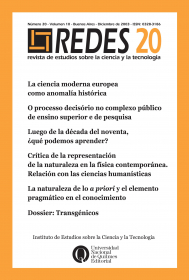
Crítica de la representación de la naturaleza en la física contemporánea. Relación con las ciencias humanísticas
DOI:
https://doi.org/10.48160/18517072re20.481Palavras-chave:
objectividad, invarianza, legalidad, matematización, computabilidadResumo
La dureza de las hipótesis de las ciencias físicas, así como la imagen de la naturaleza que de ellas se desprende sin duda han provocado una alienación conflictiva entre las ciencias humanísticas y las ciencias fácticas o físico-matemáticas. El crecimiento de las demandas de satisfacción material para sustentar un mundo muy poblado, es decir, requerimientos de eficiencia tecnológica en la conversión energética para producción, distribución y consumo, sumado a las nuevas demandas de conservación de los recursos y ambiente necesarios para esa sustentación, es decir, requerimientos de eficiencia tecnológica en la no-degradación y reconversión energética, manifiesta una dualidad conflictiva.
Las dos exigencias de eficiencia ya no pueden ser independientes, y no solo están complejamente acopladas entre sí, lo están a condicionamientos geográficos, zoológicos, sociales, económicos, políticos y culturales. Una política que maneje inadecuadamente estos problemas fracasa en lo inmediato y si la cultura los ignora, estará condenada no solo a fracasar sino a aumentarlos; el voluntarismo cultural o político alerta, como lo ha hecho en algunas ocasiones, no todas, sobre necesidades no cubiertas o situaciones y consecuencias catastróficas, pero se necesitará algo más que voluntarismo y buenas intenciones, y es conocimiento técnico del problema y, sobre todo, lucidez acerca de sus limitantes y de las consecuencias de su no-solución.
Esta complejidad interdisciplinaria sin precedentes obliga a conjeturar que la solución será global necesariamente y que no habrá soluciones parciales, porque la dimensión de exigencias tan acuciantes plantea un problema global.
La solución no podrá darla ni la comunidad de las ciencias físicas aislada, ni la comunidad de las ciencias humanísticas. Será imprescindible que se entiendan mutuamente los métodos, hipótesis de trabajo, postulados, naturaleza de sus teorías y condiciones de contorno de sus problemas específicos, para abordar en común el problema común.
Es con este propósito que escribo estas líneas, a fin de tender un puente hacia ese entendimiento; seguramente será insuficiente e incompleto, pero creo saludable plantearlo
Referências
Bachelard, G., (1948), La formación del espíritu científico, Siglo XXI.
Bachelard, G., (1953), Le matérialisme rationnel, París, Presses Universitaires.
Bunge, M., (1983), Controversias en Física, Editorial Tecnos.
Casas de Peralta M. T., (1993), "Un problema ético de la educación en la sociedad democrática de mercado. Diagnóstico a partir de la enseñanza de Física en carreras de Ingeniería", Actas, IV Jornadas de Epistemología e Historia de la Ciencia, Facultad de Filosofía y Humanidades, Universidad Nacional de Córdoba, Argentina.
Casas de Peralta, M. T., (1996), "Diagnóstico de problemas lingüísticos y cognitivos a partir de la enseñanza de Física en carreras de Ingeniería", Revista de Enseñanza de la Física, vol. 9, #1, pp. 7-13
Casas de Peralta, M. T., (1994), "La axiomática en la educación temprana y el desarrollo del cerebro", Encuentro Latinoamericano “La ciencia como modelo teórico y como realidad institucional”, Universidad Nacional de Rosario.
Casas de Peralta M. T., (1994), "La enseñanza actual de la Física en las carreras de Ingeniería. El problema ético de la educación en la sociedad democrática de mercado. Diagnóstico", Revista de Ciencia y Tecnología, Secretaría de Ciencia y Técnica, serie Divulgación, Universidad Nacional de Santiago del Estero, No 1.
Cauwerghe, M. R., Journal de Physique, No 8, p. 303, 1929. (Primera Medición en Laboratorio de la Corriente de Desplazamiento, comentarios de la autora.)
Cernea, M. M., (S/D), “Using Knowledge from Social Sciences in Development Projects”, World Bank Discussion Papers, # 114.
Funtowics, S. y Ravetz, J., (1993), “Riesgo global, incertidumbre e ignorancia” en Epistemología Política, Ciencia con la Gente, Buenos Aires, CEAL.
Gödel, K., (1981), “Über formal unentscheidbare Sätze der Principia Mathematica und verwandter Systeme”, Monatshefte für Mathematil und Physik, vol. 38, pp. 173-198, Leipzig.
Marcusse, H., (1970), El Hombre unidimensional, Biblioteca Breve de Bolsillo, Seix Barral.
Monod, J., (1985), Le hasard et la necessitè, (Essai sur la philosophie naturelle de la biologie moderne), Editions de Seuil.
Penrose, R., (1989), The Emperor’s New Mind, Oxford University Press.
Penrose, R. , (1994), The Shadows of the Mind, Oxford University Press, 1994.
Downloads
Publicado
Como Citar
Edição
Seção
Licença
Copyright (c) 2003 Redes. Revista de Estudios Sociales de la Ciencia y la TecnologíaOs documentos publicados aqui são regidos pelos critérios de licenciamento Creative Commons Argentina.Atribución - No Comercial - Sin Obra Derivada 2.5 https://creativecommons.org/licenses/by-nc-nd/2.5/ar/