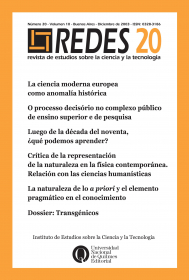
Modern european science as historic anomaly
DOI:
https://doi.org/10.48160/18517072re20.478Keywords:
modern science, religeous beliefs, science in china, epistemic frameworkAbstract
In this paper, we briefly examine the role that religious beliefs have played in the different worldviews that, in each historic period, have induced specific courses in the process of building and implementing scientific and technological knowledge. In particular, we maintain that, without excluding socioeconomic factors, the presence of metaphysical doctrines and of tight traditional religious structures in civilizations other than the European one of 16th and 17th centuries prevented them from conceiving nature as something secular and therefore hindered the emergence of modern science and capitalism. To reach a better understanding of the problem, we think it is essential to resort to sociological approaches, such as those used by Weber and Ben David. We also think it is useful to analyze the problem by means of the concept of "epistemic framework" introduced by Jean Piaget and Rolando García because it would allow us to understand in what way those frameworks have, in different civilizations and in different historic periods, promoted or hindered a certain worldview and thus have orientated the notions about nature and the approaches necessary for its study.
References
Ben-David, J. (1974), El papel de los científicos en la sociedad. Un estudio comparativo, México, Trillas.
Berman, M. (1987), El reencantamiento del mundo, Santiago de Chile, CuatroVientos Editorial.
Cohen, H. F. (1994), The Scientific Revolution. A Historiographical Inquiry, Chicago, The University of Chicago Press.
Easlea, B. (1977), La liberación social y los objetivos de la ciencia. México, Siglo XXI Editores.
García, R. (2000), El conocimiento en construcción, Barcelona, Gedisa.
Kuhn, T. S. (1982), La tensión esencial, México, FCE.
Piaget, J. y García, R. (1982), Psicogénesis e historia de la ciencia, México, Siglo XXI Editores.
Needham, J. (1977), La gran titulación. Ciencia y Sociedad en Oriente y Occidente, Madrid, Alianza Editorial.
Noble, D. F. (1999), La religión de la tecnología. La divinidad del hombre y el espíritu de invención, Buenos Aires, Paidós.
Weber, M. (1998), Ensayos sobre sociología de la religión, vol. I, Madrid, Aguilar-Taurus.
Downloads
Published
How to Cite
Issue
Section
License
Copyright (c) 2003 Redes. Journal of Social Studies of Science and TechnologyThe documents published here are governed by the licensing criteria
Creative Commons Argentina.Atribución - No Comercial - Sin Obra Derivada 2.5 https://creativecommons.org/licenses/by-nc-nd/2.5/ar/