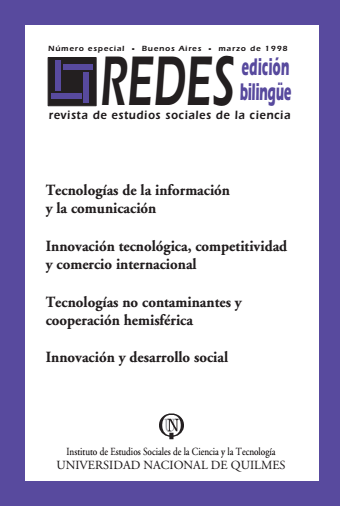
Tecnologías no contaminantes y cooperación hemisférica.
DOI:
https://doi.org/10.48160/18517072reEspecial.807Palabras clave:
tecnologías no contaminantes, cooperación hemisféricaResumen
El presente trabajo constituye un documento informativo del grupo encargado de preparar las recomendaciones para la Reunión de Ministros de Ciencia y Tecnología de las Américas. El propósito general del encuentro es fortalecer y aumentar la cooperación hemisférica en ciencia y tecnología como instrumento importante para contribuir a un desarrollo sostenido. Este trabajo quiere ser un aporte a la labor de sentar políticas y propuestas de cooperación hemisférica, puesto que brinda: un marco de referencia a través de una sucinta descripción de los temas centrales, un análisis de los principales obstáculos que entorpecen la creación y aplicación de tecnologías menos contaminantes, y áreas de prioridad para una tarea cooperativa coordinada tendiente a promover en el hemisferio las innovaciones tecnológicas con el fin de alcanzar un desarrollo sostenido.
Citas
Barnett, Andrew, International Technology Transfer and Environmentally Sustainable Development, Science Policy Research Unit, University of Sussex, U.K., septiembre de 1993.
Heaton, George R. y Banks, D., Missing Links: Technology and Environmental Improvements in the Industrializing World, Washington, World Resources Institute, 1994.
Heaton, George R., Repetto, Roberto, Sobin, Rodney, Back to the Future: US Government Policy Toward Environmentally Critical Technology, Washington, World Resources Institute, 1992.
Hirschhorn, J. S., “Pollution Prevention Implementation in Developing Countries”, by Hirschhorn & Associates, Lanham, M. D. to Duke University for USAID Contract 92-SC-USAID-1020, diciembre de 1992.
Hollod, G. J.; McCartney, R. F., Waste Reduction in the Chemical Industry: Dupont’s Approach, E. I. Dupont de nemours, Inc., 1988.
IDRC, Technology, the Environment and SMEs in the Americas: Future Research and Action, Synthesis and Recommendations of Meeting held Nov. 14-16, IDRC, Ottawa, 1995.
OAS, Scientific and Technological Cooperation in Latin America and the Caribbean, Organization of American States, OEA/Ser. J/XV.1, MCCT doc.11/93, Washington D.C., octubre de 1993.
OTA, Environmental Policy Tools: A User’s Guide, OTA, Washington, 1995.
OTA, Innovation and Commercialization of Emerging Technologies, Office of Technology Assessments, Washington D.C., 1995.
Rath, Amitav, Herbert-Copley, Brent, Green Technologies for Development: Transfer, Trade and Cooperation, International Development Research Centre, Ottawa, 1993.
Report of the Workshop on the Promotion of Access to and Dissemination of Information on Environmentally Sound Technologies (1995), Seúl, Corea, 30 de noviembre-2 de diciembre de 1994.
Smith, B., “Future Pollution Prevention Opportunities and Needs in the Textile Industry”, en Pojasek, B. (ed.), Pollution Prevention Needs and Opportunities, Center for Hazardous Materials Research, mayo de 1994.
UNEP, Government Strategies and Policies for Cleaner Production, United Nations Environment Programme, París, 1994.
UNEP, Cleaner Production Worldwide, vol. II, United Nations Environment Programme, París, 1995.
United Nations, “Transfer of Environmentally Sound Technologies, Cooperation and Capacity Building”, Report of the Secretary General, United Nations, Economic and Social Council, E/CN17/1995/17, 20 de marzo de 1995.
United Nations, “Education, Science, Transfer of Environmentally Sound Technologies, Cooperation and Capacity Building”, United Nations, Economic and Social Council, E/CN17/1995/L6, 25 de abril de 1995.
World Commission on Environment and Development, Our Common Future, Oxford University Press, Nueva York, 1987.
Publicado
Cómo citar
Número
Sección
Licencia
Derechos de autor 1998 Redes. Revista de Estudios Sociales de la Ciencia y la TecnologíaLos documentos aquí publicados se rigen bajos los criterios de licencia Creative Commons Argentina.Atribución - No Comercial - Sin Obra Derivada 2.5 https://creativecommons.org/licenses/by-nc-nd/2.5/ar/