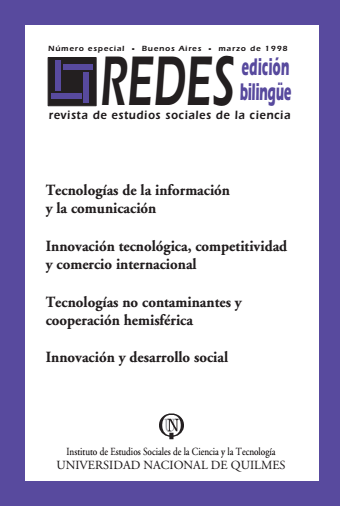
Clean technologies and hemispheric cooperation.
DOI:
https://doi.org/10.48160/18517072reEspecial.807Keywords:
clean technologies, hemispheric cooperationAbstract
This paper provides a background document for the working group preparing recommendations for the Meeting of the Ministers for Science and Technology in the Americas. The general objective of the meeting is to strengthen and increase hemispheric cooperation in science and technology as an important instrument for contributing to sustainable development. This paper intends to contribute to the development of policies and proposals for hemispheric cooperation by providing: (i) a frame of reference by means of a succinct description of the main issues, (ii) from the above, and based on an examination of major obstacles, the development and applications of clean technologies, and (iii) priority areas for coordinated and cooperative efforts in the hemisphere to promote technological innovations for sustainable development.
References
Barnett, Andrew, International Technology Transfer and Environmentally Sustainable Development, Science Policy Research Unit, University of Sussex, U.K., septiembre de 1993.
Heaton, George R. y Banks, D., Missing Links: Technology and Environmental Improvements in the Industrializing World, Washington, World Resources Institute, 1994.
Heaton, George R., Repetto, Roberto, Sobin, Rodney, Back to the Future: US Government Policy Toward Environmentally Critical Technology, Washington, World Resources Institute, 1992.
Hirschhorn, J. S., “Pollution Prevention Implementation in Developing Countries”, by Hirschhorn & Associates, Lanham, M. D. to Duke University for USAID Contract 92-SC-USAID-1020, diciembre de 1992.
Hollod, G. J.; McCartney, R. F., Waste Reduction in the Chemical Industry: Dupont’s Approach, E. I. Dupont de nemours, Inc., 1988.
IDRC, Technology, the Environment and SMEs in the Americas: Future Research and Action, Synthesis and Recommendations of Meeting held Nov. 14-16, IDRC, Ottawa, 1995.
OAS, Scientific and Technological Cooperation in Latin America and the Caribbean, Organization of American States, OEA/Ser. J/XV.1, MCCT doc.11/93, Washington D.C., octubre de 1993.
OTA, Environmental Policy Tools: A User’s Guide, OTA, Washington, 1995.
OTA, Innovation and Commercialization of Emerging Technologies, Office of Technology Assessments, Washington D.C., 1995.
Rath, Amitav, Herbert-Copley, Brent, Green Technologies for Development: Transfer, Trade and Cooperation, International Development Research Centre, Ottawa, 1993.
Report of the Workshop on the Promotion of Access to and Dissemination of Information on Environmentally Sound Technologies (1995), Seúl, Corea, 30 de noviembre-2 de diciembre de 1994.
Smith, B., “Future Pollution Prevention Opportunities and Needs in the Textile Industry”, en Pojasek, B. (ed.), Pollution Prevention Needs and Opportunities, Center for Hazardous Materials Research, mayo de 1994.
UNEP, Government Strategies and Policies for Cleaner Production, United Nations Environment Programme, París, 1994.
UNEP, Cleaner Production Worldwide, vol. II, United Nations Environment Programme, París, 1995.
United Nations, “Transfer of Environmentally Sound Technologies, Cooperation and Capacity Building”, Report of the Secretary General, United Nations, Economic and Social Council, E/CN17/1995/17, 20 de marzo de 1995.
United Nations, “Education, Science, Transfer of Environmentally Sound Technologies, Cooperation and Capacity Building”, United Nations, Economic and Social Council, E/CN17/1995/L6, 25 de abril de 1995.
World Commission on Environment and Development, Our Common Future, Oxford University Press, Nueva York, 1987.
Published
How to Cite
Issue
Section
License
Copyright (c) 1998 Redes. Journal of Social Studies of Science and TechnologyThe documents published here are governed by the licensing criteria
Creative Commons Argentina.Atribución - No Comercial - Sin Obra Derivada 2.5 https://creativecommons.org/licenses/by-nc-nd/2.5/ar/