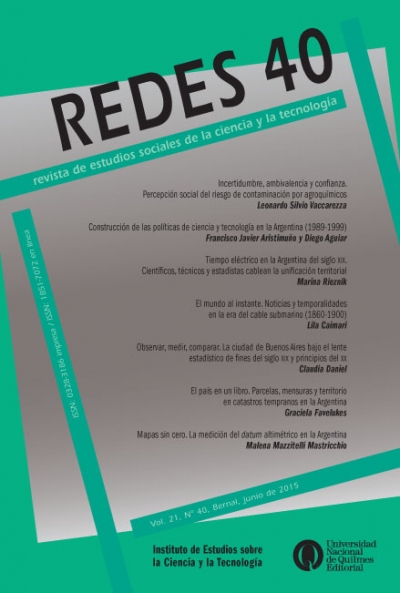
Electric time at 19th Century Argentina: Scientists, technicians and statesmen wiring territorial unification
DOI:
https://doi.org/10.48160/18517072re40.611Keywords:
time, telegraph, 19th century, argentinaAbstract
At the end of XIX century, several legal dispositions were draw in Argentina in order to unify national time standard. The goal was to reach coordination through telegraphic signals. The intents to measure time as well as appropriately synchronize local times were based on the need for coordinating distant activities across a vast area that was starting to be considered as a unified territory. The directors of Observatories at Cordoba and La Plata participated in the social networks of people that were trying to carry out this adjustment. The institution from Cordoba was to be also in charge of fixing a unified time standard, which was going to run over the telegraphic wires.
But, before that, the main questions for this paper are about the way that astronomic knowledge and labour technologies had an impact on the statesman from that era –in this case, meaning the ones who displayed their will for a national synchronization– and vice versa, the way in which the wide social transformations from that time had an impact on the targets set by the directors of the observatories while developing their activities. These questions involves both telegraphic and clock making technologies; the transformations in the labour world –which made it necessary to minutely control times and rhythms during the working day; and the intents of mapping the national territories, among other issues.
References
• Airy, G. (2010) [1896], Autobiography of Sir George Airy, Cambridge, Cambridge University Press.
• Alder, K. (2002), The Measure of All Things, Nueva York, The Free Press.
• Anónimo (1857), “Telegraphs and Progress. The Cause”, Littell’s Living Age, N° 3, enero, p. 58.
• Anónimo (1858), “The Atlantic Telegraph, Ancient Art, and Modern Progress”, DeBow’s Review, vol. 25, pp. 5-8.
• Anónimo (1884), “Le nouvel observatoire astronomique de La Plata”, Bulletin Astronomique, serie i, pp. 63-64.
• Bartky, I. (1988), The Adoption of Standard Time, Detroit, Wayne State University Press.
• Bartky, I. (2007), One fits all: the campaigns for global uniformity, California, Stanford University Press.
• Bell, T. (2002), “The Victorian Global Positioning System”, The Bent of Tau Beta Pi, pp. 14-21.
• Benjamin, G. (1879), Carta al presidente Avellaneda, 10 de diciembre de 1879.
• Benjamin, G. (1856), “Inauguration of the Dudley Observatory at Albany”, 28 de agosto.
• Bernaola, O. (2001), Enrique Gaviola y el Observatorio Astronómico de Córdoba. Su impacto en el desarrollo de la ciencia argentina, Buenos Aires, Saber y Tiempo.
• Blaise, C. (2000), Time Lord. Sir Standford Fleming and the Creation of Standard Time, Londres, Weidenfeld & Nicolson.
• Boistel, G. (2006), Instruire les marins avec les mohines du bord: Observatoire de Montsouri, París, Les Genies de la Science.
• Canales, J. (2001), “Exit the frog, enter the human: physiology and experimental psychology in nineteenth-century astronomy”, The British Journal for the History of Science, vol. 34, parte 2, N° 121, pp. 171-197.
• Canales, J. (2009), A tenth of a second: a history, Chicago, The University of Chicago Press.
• Carrasco, G. (1893), La unidad horaria en la República, Rosario, Peuser.
• Channing, W. (1852), “On the Municipal Electric Telegraph; Especially in its Application to Fire Alarms”, American Journal of Science and Arts, N° 13, pp. 58-59.
• Chapman, A. (1983), “The accuracy of angular measuring instruments used in astronomy between 1500 and 1850”, Journal for the History of Astronomy, N° 14, pp. 133-137.
• Cleveland, A. (1879), Report on Standard Time to the American Meteorological Society, Estados Unidos, Proceedings of the ams.
• Crosby, A. (1997), The Measurement of Reality, Cambridge, Cambridge University Press.
• Czitrom, D. (1982), Media and the American Mind: From Morse to McLuhan, Chapel Hill, University of North Carolina Press.
• Field, A. J. (1992), “The Magnetic Telegraph, Price and Quantity Data, and the New Management of Capital”, The Journal of Economic History, vol. 52, N° 2, pp. 401-413.
• Galison, P. (2003), Relojes de Einstein, mapas de Poincaré. Los imperios del tiempo, Barcelona, Crítica.
• Gilmore, P. (2002), “The Telegraph in Black and White”, elh, vol. 69, N° 3, pp. 805-833.
• Gould, B. A. (1884), Informe de actividades elevado al ministerio de jcip, Carta a Eduardo Wilde, 9 de abril.
• Gould, B. A. (1870-1873), “Copiador 1”, manuscrito, ona, Córdoba, Observatorio Astronómico de Córdoba.
• Gould, B. A. (1878-1888), “Copiador 3”, manuscrito, ona, Córdoba, Observatorio Astronómico de Córdoba.
• Hartmann, J. (1928), Nueva determinación de la longitud geográfica del Observatorio Astronómico de La Plata, La Plata, unlp Publicaciones.
• Headrick, D. (1981), The Tools of Empire: Technology and European imperialism in the nineteenth century, Oxford, Oxford University Press.
• Hoffman, C. (2007), “Constant differences: Friedrich Wilhelm Bessel, the concept of the observer in early nineteenth-century practical astronomy and the history of personal equation”, The British Journal for the History of Science, vol. 40, pp. 333-366.
• Huurdeman, A. (2003), The Worldwide History of Telecommunications, Nueva Jersey, John Wiley & Sons.
• Lehmkuhl, U. (2005), “Atlantic Communication: The Media in American and German History from the 17th to the 20th Century”, Journal of American History, vol. 92, N° 3, pp. 25-48.
• Lenoir, T. (1988), “Inscription practices and materialities of communication”, en Lenoir, T. (ed.), Inscribing Science: Scientific Texts and the Materialities of Communication, Stanford, Stanford University Press, pp. 1-19.
• Marshall, P. (2001), The eighteenth century, Oxford, Oxford University Press.
• Mouchez, A. (1882), “Observation du passage de Vénus dans la République argentine”, Comptes Rendus Hebdomadaires des Séances de l’Académie des Sciences, N° 95, pp. 1182-1184.
• Müller-Pohl, S. (2010), “‘By Atlantic Telegraph’. A Study on Weltcommunication in the 19th Century”, Medien & Zeit, N° 4, pp. 40-54.
• Otero, H. (1998), “Estadística censal y construcción de la nación. El caso argentino, 1896-1914”, Boletín del Instituto de Historia Argentina y Americana Dr. Emilio Ravigniani, 3a serie, N° 16-17, pp. 124-149.
• Palau Baquero, M. (1987), “Expediciones científicas en América en el siglo xviii”, Astronomía y cartografía de los siglos xviii y xix, Madrid, Observatorio Astronómico Nacional, p. 33.
• Paolantonio, S. (2014), “Cronógrafo M. Hipp del Observatorio Nacional Argentino”. Disponible en <https://historiadelaastronomia.wordpress. com/documentos/cronografohipp/>, consultado el 10 de marzo de 2015.
• Paolantonio, S. y E. Minniti (2011), “Señales horarias. Historia temprana de la hora oficial argentina”. Disponible en .
• Perrin, E. (1883), “Observation du passage de Vénus, faite à Bragado (République Argentine)”, Comptes Rendus Hebdomadaires des Séances de l’Académie des Sciences, N° 97, pp. 227-229.
• Plotkin, M. y E. Zimmermann (comps.) (2012), Los saberes del Estado, Buenos Aires, Edhasa.
• Podgorny, I. (2012), “De cómo Mylodon robustus surgió de los huesos de Glyptodon. El comercio de huesos en el Río de la Plata y la sistemática de los mamíferos fósiles en 1840”, Revista del Museo de La Plata, sección Paleontología, vol. 12, N° 67, pp. 43-64.
• Pyenson, L. (1985), Cultural Imperialism and Exact Sciences: German Expansion Overseas, 1900-1930, Nueva York, Peter Lang.
• Pyenson, L. (1993), Civilizing Mission: Exact Sciences and French Overseas Expansion, 1830-1940, Baltimore, Johns Hopkins University Press.
• Radau, R. (1867), L’Acoustique ou les phénoménes du son, Bibliotheque des Merveilles, París, Librairie Hachette et Cie.
• Rieznik, M. (2009), “Convenciones espacio-temporales y tecnologías de transporte y comunicación en la Argentina del siglo xix”, xxvii Congreso alas, Buenos Aires.
• Rieznik, M. (2011), Los cielos del sur. Los observatorios astronómicos de Córdoba y de La Plata, 1870-1920, Rosario, Prohistoria, col. Historia de la Ciencia.
• Rieznik, M. (2013), “Dibujando con alambres la espaciotemporalidad en la Argentina del siglo xix. Los esquemas de tendidos telegráficos diagramados por Manuel Bahía (1891)”, en Lois, C. y V. Hollman (eds.), Geografía y cultura visual: los usos de las imágenes en las reflexiones sobre el espacio, Rosario, Prohistoria, pp. 351-367.
• Rieznik, M. (2014), “Velocidad telegráfica y coordinación horaria en la Argentina (1875-1913)”, Boletín del Instituto de Historia Argentina y Americana Dr. Emilio Ravignani, 3a serie, N° 40, primer semestre, pp. 42-72.
• Rogers, W. (1883), “The German Survey of the Northern Heaven”, Science, vol. 2, N° 29, pp. 229-237.
• Safford, T. (1896), “The Psychology of the Personal Equation”, Science, vol. 4, N° 84, pp. 170-171.
• sca [Sociedad Científica Argentina] (1979), La evolución de las ciencias en la República Argentina, 1923-1972, t. vii, Astronomía, Buenos Aires, Sociedad Científica Argentina.
• Schaffer, S. (1988), “Astronomers mark time: discipline and personal equation”, Science in Context, N° 2, pp. 115-145.
• Schaffer, S. (1994), “Babbage’s Intelligence: Calculating Engines and the Factory System”, Critical Inquiry, vol. 21, N° 1, pp. 203-227.
• Standage, T. (1998), The Victorian Internet: The Remarkable Story of the Telegraph and the Nineteenth Century’s On-line Pioneers, Nueva York, Walker and Co.
• Staubermann, K. (2001), “Making stars: projection culture in nineteenth-century german astronomy”, The British Journal for the History of Science, vol. 34, parte 4, N° 123, pp. 439-451.
• Thompson, R. L. (1947), Wiring a Continent: The History of the Telegraph Industry in the United States, 1832-1866, Princeton, Princeton University Press.
• Ure, A. (1835), The Philosophy of Manufactures, Londres, Charles Knight.
• Welch, K. (1972), Time Measurement. An Introductory History, Gran Bretaña, Newton.
Downloads
Published
How to Cite
Issue
Section
License
Copyright (c) 2015 Redes. Journal of Social Studies of Science and TechnologyThe documents published here are governed by the licensing criteria
Creative Commons Argentina.Atribución - No Comercial - Sin Obra Derivada 2.5 https://creativecommons.org/licenses/by-nc-nd/2.5/ar/