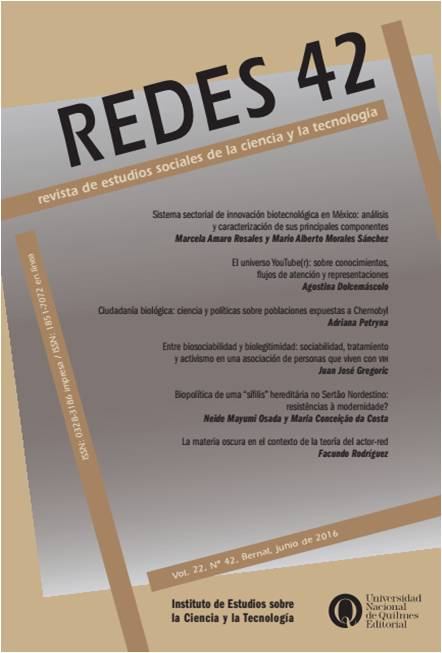
Biopolítica de uma “sífilis” hereditária no sertão nordestino: resistências à modernidade?
DOI:
https://doi.org/10.48160/18517072re42.597Palavras-chave:
enfermedad genética rara, biopolítica, biomedicalización, necropolíticaResumo
Este artigo analisa a construção social de uma doença genética no sertão nordestino a partir da perspectiva teórica dos Estudos Sociais da Ciência e da Tecnologia, com foco nos processos de biomedicalização, biopolítica e necropolítica. Uma doença tradicionalmente conhecida por sífilis foi rediagnosticada como Síndrome de Spoan duzentos por um grupo de pesquisadores que tiveram um papel crucial na introdução do conhecimento científico nessa comunidade. No entanto, as resistências surgiram tanto por parte dos pacientes e familiares quanto do próprio poder público local, por distintas razões. Dessa forma, para compreender essas resistências, a metodologia adotada foi uma revisão da literatura que aborda as transformações no campo da saúde; uma etnografia de laboratório realizada nos laboratórios do Centro de Estudo do Genoma Humano da Universidade de São Paulo (cegh-usp), entrevistas com pesquisadores e coleta de dados secundários sobre doenças genéticas raras que ocorrem em maior frequência. As conclusões da pesquisa apontam que para compreender uma doença que tem dois nomes é preciso primeiramente entender o seu contexto cultural, a biopolítica aplicada e as relações de sociabilidade criadas a partir da doença e, em segundo lugar, aponta que substituir as narrativas tradicionais pelo discurso das ciências em um lugar que resiste à própria ciência pode ser um alerta de que estamos impondo uma visão de mundo que pode não ser bom para Serrinha dos Pintos.
Referências
Appadurai, A. (1996), Modernity at Large: Cultural Dimensions of Globalization, Mineápolis, University of Minneapolis Press.
Bourdieu, P. (2007), A distinção. Crítica social do julgamento, San Pablo/Porto Alegre, edusp/Zouk.
Callon, M. y V. Rabeharisoa (2003), “Research ‘in the wild’ and the shaping of new social identities”, Technology in Society, vol. 25, Nº 2, pp. 193-204.
Clarke, A. et al. (2003), “Biomedicalization: Technoscientific Transformations of Health, Illness, and us Biomedicine”, American Sociological Review, vol. 68, Nº 2, pp. 161-194.
Clarke, A. et al. (eds.) (2010), Biomedicalization: Technoscience, Health, and Illness in the us, Durham/Londres, Duke University Press.
Cooper, M. (2008), Life As Surplus: Biotechnology and Capitalism in the Neoliberal Era, Seattle, University of Washington Press.
Foucault, M. (1999), História da Sexualidade. Volume 1, Río de Janeiro, Graal.
Geertz, C. (2008), A Interpretação das Culturas, 13ª reimpr., Río de Janeiro, ltc.
Jasanoff, S. (2004), “The idiom of co-production”, en Jasanoff, S. (ed.), States of Knowledge: the Co-production of Science and Social Order, Londres/Nueva York, Routledge, pp. 1-12.
Jasanoff, S. y S-H. Kim (eds.) (2015), Dreamscapes of Modernity: Sociotechnical Imaginaries and the Fabrication of Power, Chicago, University of Chicago Press.
Latour, B. (2004), Politics of Nature: How to Bring the Sciences into Democracy, Londres, Harvard University Press.
Martin, E. (1994), Flexible Bodies: Tracking Immunity in American Culture: From Days of Polio to the Age of aids, Boston, Beacon Press.
Mbembe, A. (2003), “Necropolitics”, Public Culture, vol. 15, Nº 1, pp. 11-40.
Nydal, R., S. Efstathiou y A. Laegreid (2011), Crossover Research: exploring the third mode of integration, Trondheim, NTNU.
Osada, N. (2006), “Fazendo gênero nas Ciências: uma análise das relações de gênero na produção do conhecimento do Projeto Genoma da Fapesp”, tesis de maestría, Programa de Pós-Graduação em Política Científica e Tecnológica, Instituto de Geociéncias, Campinas, Unicamp.
Osada, N. (2012), “O processo de biomedicalização no Brasil: Estudo da prática científica em pesquisas sobre doenças genéticas”, tesis de doctorado en Política Científica e Tecnológica, Instituto de Geociéncias, Campinas, Unicamp.
Osada, N. y M. Costa (2006), “Construção social de gênero na Biologia: preconceitos e obstáculos na biologia molecular”, Cadernos Pagu, vol. 27, pp. 279-299.
Pickering, A. (1995), The Mangle of Practice, Chicago, University of Chicago Press.
Rabinow, P. (1996), Essays on the Anthropology of Reason, Princeton, Princeton University Press.
Rabinow, P. y N. Rose (2006), “O conceito de biopoder hoje. Política e Trabalho”, Revista de Ciências Sociais, Nº 24, pp. 27-57.
Rose, N. (2007a), “Genomic suscetibility as an emergency form of life”, en Burri, R. y J. Dumit, Biomedicine as Culture, Nueva York, Routledge, pp. 141-150.
Rose, N. (2007b), The Politics of Life Itself: Biomedicine, Power and Subjetivity in the Twenty-First Century, Princeton, Princeton University Press.
Santos, S. y N. Bizzo (2005), “From ‘New Genetics’ to Everyday Knowledge: Ideas About How Genetic Diseases Are Transmitted in Two Large Brazilian Families”, Science Education, vol. 84, Nº 4, pp. 564-576.
Thompson, C. (2005), Making Parents: The Ontological Choreography of Reproductive Technologies, Cambridge/Londres, The MIT Press.
Downloads
Publicado
Como Citar
Edição
Seção
Licença
Copyright (c) 2016 Redes. Revista de Estudios Sociales de la Ciencia y la TecnologíaOs documentos publicados aqui são regidos pelos critérios de licenciamento Creative Commons Argentina.Atribución - No Comercial - Sin Obra Derivada 2.5 https://creativecommons.org/licenses/by-nc-nd/2.5/ar/