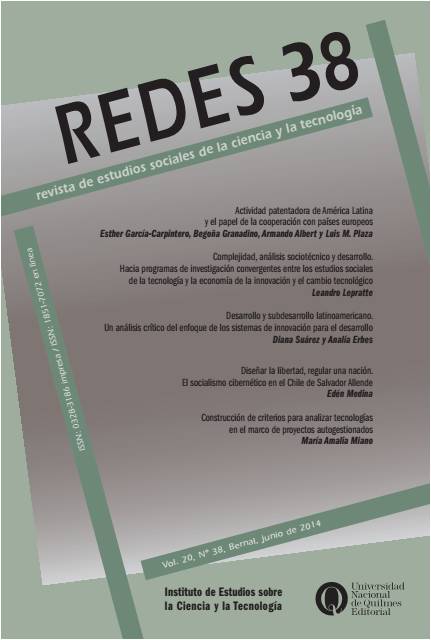
Building criteria to analyze technologies within self- managed enterprises
DOI:
https://doi.org/10.48160/18517072re38.539Keywords:
technology, self-managed projects, autonomyAbstract
Based on theoretical insights drawn from several philosophers of technology, this paper is aimed to contour useful criteria to analyze the way in which technology works within social organizations other from those distinctive of capitalist societies. We address the ways in which technology is conceived at self-managed enterprises, the ways in which their members interact with technology, being groups of people bonded to rules as equity among their members, reflection about their own praxis, ability to build up and questioning their own regulations. Following that, we ask, does a different social organization demand the employment of different technologies?, if so, which would be their charac¬teristics, in order to be adequate to this new kind of social organizations?
To answer these questions, in this article we analyze the data gathered within an eighteen months fieldwork carried out at a self-managed enterprise which produces front axle and suspension system spare parts for cars.
Some outcomes from the case inform that, even if workers doesn’t question nor make structural changes on technologies they deal with, they do build reckon criteria for those technologies that differs from another productive environments. Furthermore, as collective management is a characteristic feature of these self-managed enterprises, workers have the chance to get involved with decision making process, even about the design of technologies that could be incorporated to production.
References
Adorno, T. y M. Horkheimer (1969), Dialéctica del iluminismo, Buenos Aires, Sur.
Bookchin, M. (1999), La ecología de la libertad, Madrid, Nossa y Jara.
Castoriadis, C. (1990), El mundo fragmentado, Buenos Aires, Altamira.
Castoriadis, C. (2005), Figuras de lo pensable, Buenos Aires, Fondo de Cultura Económica.
Castoriadis, C. (2007), La institución imaginaria de la sociedad, Buenos Aires, Tusquets.
Escobar, A. (2005), “Bienvenidos a Cyberia. Notas para una antropología de la cibercultura”, Revista de Estudios Sociales, Nº 22, pp. 15-35.
Feenberg, A. (1991), Critical theory of technology, Nueva York, Oxford University Press.
Geertz, C. (1987), La interpretación de las culturas, México, Gedisa.
Guber, R. (2001), La etnografía. Método, campo y reflexividad, Bogotá, Grupo Editorial Norma.
Habermas, J. (1968), Ciencia y técnica como ideología, Madrid, Tecnos.
Heras, A. I. (2011), “Pensar la autonomía. Dispositivos y mecanismos en proyectos de autogestión”, Intersecciones en Comunicación, Nº 5, pp. 31-64.
Heras, A. I. y A. Miano (2012), “El lenguaje audiovisual en la investigación social y la comunicación pública del conocimiento”, Revista Ciencias, Público y Sociedad, vol. 1, Nº 1, pp. 16-40.
Marcuse, H. (2005), El hombre unidimensional, Barcelona, Ariel.
Marx, K. (1980), Capital y tecnología (manuscritos inéditos 1861-1863), México, Terra Nova.
Marx, K. (1984) [1847], Miseria de la filosofía, Madrid, Aguilar.
Marx, K. (1987) [1867], El capital, México, Siglo XXI.
Mesa Colectiva (2013), “La autonomía como proyecto: procesos de reflexión deliberada en experiencias de autogestión”, Revista Pueblos y Fronteras, vol. 3, Nº 15, pp. 56-91.
Miano, A. (2012), “A este pueblo le vino la modernización de golpe. Reconfiguración de saberes y sentidos en torno a la tecnología en una comuna del sur de la provincia de Santa Fe”, tesis doctoral, Facultad de Ciencias Sociales, Universidad de Buenos Aires.
Mitcham, C. (1989), “Tres formas de ser con la tecnología”, Anthropos, Nº 14, pp. 13-25.
Mumford, L. (1982), Técnica y civilización, Madrid, Alianza.
Mumford, L. (1989), “Técnicas autoritarias y democráticas”, Anthropos, Nº 14, pp. 127-131.
Noble, D. (1984), Forces of Production. A Social History of Industrial Automation, Nueva York, Knopf.
Noble, D. (2001), La locura de la automatización, Barcelona, Alikornio.
Novaes, H. (2005), “Para além da apropriação dos meios de produção? O processo de Adequação Sócio-Técnica em Fábricas Recuperadas”, tesis de maestría en Política Científica y Tecnológica, Universidade Estadual de Campinas, San Pablo.
Parente, D. (2006), “Algunas precisiones sobre el determinismo tecnológico y la tecnología autónoma. Una lectura sobre la filosofía de Langdon Winner”, Redes, vol. 12, Nº 23, Bernal, Editorial de la Universidad Nacional de Quilmes, pp. 79-102.
Schmucler, H. (1997), “Apuntes sobre el tecnologismo o la voluntad de no querer”, Artefacto, Nº 1, pp. 6-9.
Winner, L. (1986), “Do artifacts have politics?”, en Winner, L., The whale and the reactor: a search for limits in an age of high technology, Chicago, University of Chicago Press, pp. 19-39.
Winner, L. (1992), “La carrera tecnológica y la cultura política”, en San Martín, J. et al. (eds.), Estudios sobre sociedad y tecnología, Barcelona, Anthropos, pp. 287-301.
Winner, L. (1993), “Upon opening the Black box and finding it empty: Social Constructivism and the Philosophy of the Technology”, Science, Technology and Human Values, vol. 18, Nº 3, pp. 362-378.
Downloads
Published
How to Cite
Issue
Section
License
Copyright (c) 2014 Redes. Journal of Social Studies of Science and TechnologyThe documents published here are governed by the licensing criteria
Creative Commons Argentina.Atribución - No Comercial - Sin Obra Derivada 2.5 https://creativecommons.org/licenses/by-nc-nd/2.5/ar/