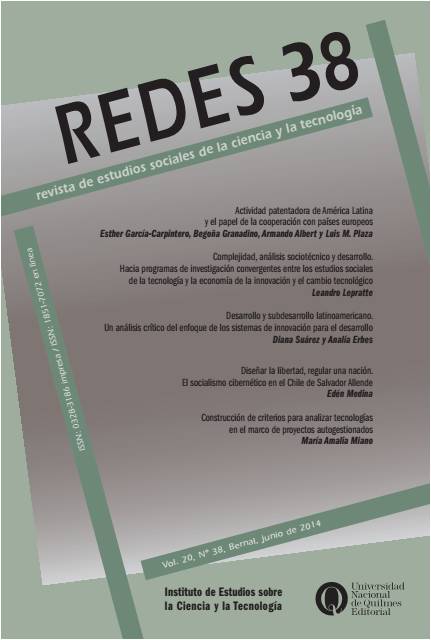
Latin America patenting activity and the role of cooperation with European countries
DOI:
https://doi.org/10.48160/18517072re38.535Keywords:
technological cooperation, patents, latin america, european unionAbstract
The present work forms part of the eularinet (European Union-Latin America Research and Innovation Network) project aimed at strengthening the bi-regional cooperation in Science and Technology. Its goal is to determine the production and the technological capacities of Latin American countries, especially focused in the cooperation between them and the European countries, through patent indicators. Prior studies have demonstrated that the dynamics of scientific cooperation between European and Latin American countries are strongly consolidated, though data from this study show that technological cooperation is very scarce. The results of initiatives in the field of analysis for strategic planning, as the project eularinet, provide a basis of essential knowledge so that European countries can optimise strategies of scientific and technological cooperation with Latin American countries.
References
Albornoz, M. (2012), Estado de la ciencia. Principales Indicadores de ciencia y tecnología iberoamericanos e interamericanos, Buenos Aires, ricyt.
Albornoz, M. y L. Plaza (eds.) (2011), Agenda 2011. Temas de indicadores de ciencia y tecnología, Buenos Aires, ricyt.
Alcázar Farías, E. y A. Lozano Guzmán (2009), “Desarrollo histórico de los indicadores de ciencia y tecnología, avances en América Latina y México”, Revista Española de Documentación Científica, vol. 32, Nº 3, pp. 119-126.
Banco Interamericano de Desarrollo (bid) (2006), Educación, ciencia y tecnología en América Latina y el Caribe. Un compendio estadístico de indicadores, Washington, Banco Interamericano de Desarrollo.
Bonfiglioli, A. y E. Marí (2000), “La cooperación científico-tecnológica entre la Unión Europea y América Latina: el actual contexto internacional y el Programa Marco de la Unión Europea”, Redes. Revista de Estudios Sociales de la Ciencia y la Tecnología, vol. 7, Nº 15, Bernal, Editorial de la Universidad Nacional de Quilmes, pp. 183-208.
Borgatti, S. P. (2002), NetDraw Software for Network Visualization, Lexington, Analytic Technologies.
Borgatti, S. P., M. G. Everett y L. C. Freeman (2002), ucinet for Windows: Software for Social Network Analysis, Harvard, Analytic Technologies.
Criscuolo, P. (2006), “The ‘home advantage’ effect and patent families. A comparison of oecd triadic patents, the uspto and the epo”, Scientometrics, vol. 66, Nº 1, pp. 23-41.
Cuadros, A., A. Martínez y F. Torres (2008), “Determinantes de éxito en la participación de los grupos de investigación latinoamericanos en programas de cooperación científica internacional”, Interciencia, vol. 33, Nº 11, pp. 821-828.
Dachs, B. y A. Pyka (2009), “What drives the internationalization of innovation? Evidence from European patent data”, Economics of Innovation and New Technology, vol. 19, Nº 1, pp. 71-86.
Da Motta e Albuquerque, E. (2004), “Science and technology systems in Less Developed countries: identifying a threshold level and focusing in the cases of India and Brazil”, en Moed, H., W. Glänzel y U. Schmoch (eds.), Handbook of quantitative science and technology research: the use of publication and patent statistics in studies on s&t systems, Dordrecht, Kluwer Academic Publishers, pp. 759-778.
Disdier, A. y K. Head (2008), “The Puzzling Persistence of the Distance Effect on Bilateral Trade”, The Review of Economics and Statistics, vol. 90, Nº 1, pp. 37-48.
European Commission (2008), “Communication from the Commission to the Council and the European Parliament. A Strategic European Framework for International Science and Technology Cooperation”, Bruselas, European Commission. Disponible en <http://ec.europa.eu/research/press/2008/ pdf/com_2008_588_en.pdf>.
García-Carpintero, E., L. Plaza y A. Albert (2011), “Cooperación tecnológica entre América Latina y Europa: análisis de indicadores de patentes”, en Albornoz, M. y L. Plaza (eds.), Agenda 2011. Temas de indicadores de cien¬cia y tecnología, Buenos Aires, ricyt, pp. 193-206.
Guellec, D. y B. van Pottelsberghe de la Potterie (2001), “The internationalisation of technology analysed with patent data”, Research Policy, vol. 30, Nº 8, pp. 1253-1266.
Hoekman, J., F. Koen y R. J. W. Tijssen (2010), “Research collaboration at a distance: Changing spatial patterns of scientific collaboration within Europe”, Research Policy, vol. 39, Nº 5, pp. 662-673.
Leamer, E. y J. Levinsohn (1995), “International trade theory: The evidence”, en Grossman, G. M. y K. Rogoff (eds.), Handbook of International Economics, vol. iii, Amsterdam, Elsevier Science, pp. 1339-1394.
Lemarchand, G. A. (2012), “The long-term dynamics of co-authorship scientific networks: Iberoamerican countries (1973-2010)”, Research Policy, vol. 41, Nº 2, pp. 291-305.
Mattsson, P. et al. (2008), “Intra-EU vs. extra-EU scientific co-publication patterns in EU”, Scientometrics, vol. 75, Nº 3, pp. 555-574.
Montobbio, F. (2007), “Patenting Activity in Latin American and Caribbean Countries”, presentado en la Reunión Regional de Expertos sobre Sistemas de Propiedad Intelectual y Gestión Tecnológica en Economías Abiertas: Una Visión Estratégica para América Latina, organizado por wipo y cepal, Santiago de Chile, 7-9 de mayo de 2007.
Mu-Hsuan H., D. Huei-Ru y Ch. Dar-Zen (2012), “Globalization of collaborative creativity through cross-border patent activities”, Informetrics, vol. 6, Nº 10, pp. 226–236.
Narin, F. (1994), “Patent Bibliometrics”, Scientometrics, vol. 30, Nº 1, pp. 147-155.
Plaza, L. M. y A. Albert (2008), “Scientific literature cited in uspto patent documents as indicators for the evaluation and analysis of Spanish scientific research in biomedical disciplines”, Scientometrics, vol. 76, Nº 3, pp. 429-438.
Russell, J. M. (2000), “Publication indicators in Latin America revisited”, en Cronin, B. y H. B. Atkins (eds.), The web of knowledge: A festschrift in honor of Eugene Garfield, Medford, Information Today, pp. 233-250.
Sáenz, T. W. y M. C. de Souza Paula (2002), “Considerações sobre indicadores de inovação para America Latina”, Interciencia, vol. 27, Nº 8, pp 430-437.
Tijssen, R. J. W. (2001), “Global and domestic utilization of industrial relevant science: patent citation analysis of science-technology interactions and knowledge flows”, Research Policy, vol. 30, Nº 1, pp. 35-54.
Downloads
Published
How to Cite
Issue
Section
License
Copyright (c) 2014 Redes. Journal of Social Studies of Science and TechnologyThe documents published here are governed by the licensing criteria
Creative Commons Argentina.Atribución - No Comercial - Sin Obra Derivada 2.5 https://creativecommons.org/licenses/by-nc-nd/2.5/ar/