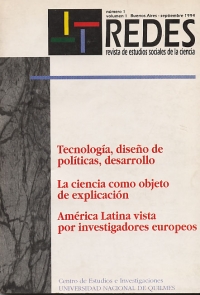
Technology, policy design, development
DOI:
https://doi.org/10.48160/18517072re1.19Keywords:
Technology, Science, Economic DevelopmentAbstract
That the problem of underdevelopment has multiple facets and requires, for its understanding, the superposition of different levels of analysis does not seem new. However, what is essential today is to strongly attack the myth created about the miraculous effects of technological change as a central element of any development strategy. In this sense, this article begins by identifying a substantive difference: there is not one Third World, but several. Consequently, it is essential to contextualize each national universe in order to understand the determinants specific to each social reality.
Indeed, scientific and technological development needs to prepare the ground, in institutional, social, economic, and political terms, since strategies that do not take this into account are destined to fail. Although science is universal, very few developing countries currently have the conditions for conducting "excellent" science. For the rest, science can rather help understand some principles and processes of local or regional importance. Perhaps one of the elements that emerge from this discussion refers to the training strategies for scientists, middle managers, managers, etc., that developing countries must implement.
References
Fauvel-Rouif, D. (ed.) (1989), Innovation technologique et civilisation, París, CNRS.
Hirschman, A. (1967) "The Principie of the Hiding Hand", The Public Interest, 6, pp. 10-23
Hirschman, A. (1981), Essays in Trespassing: Economics to Politics and Beyond, Cambridge, Cambridge University Press.
International Council for Science Policy Studies (1991), Science and Tecnology in Developing Countries: Strategies for the 90's, UNESCO.
Salomon, J.J y A. Lebeau, (1988), L 'ócnvain public et I 'ordinateur. Mirages du developpement, París, Hachette.
Downloads
Published
How to Cite
Issue
Section
License
Copyright (c) 1994 Universidad Nacional de QuilmesThe documents published here are governed by the licensing criteria
Creative Commons Argentina.Atribución - No Comercial - Sin Obra Derivada 2.5 https://creativecommons.org/licenses/by-nc-nd/2.5/ar/