
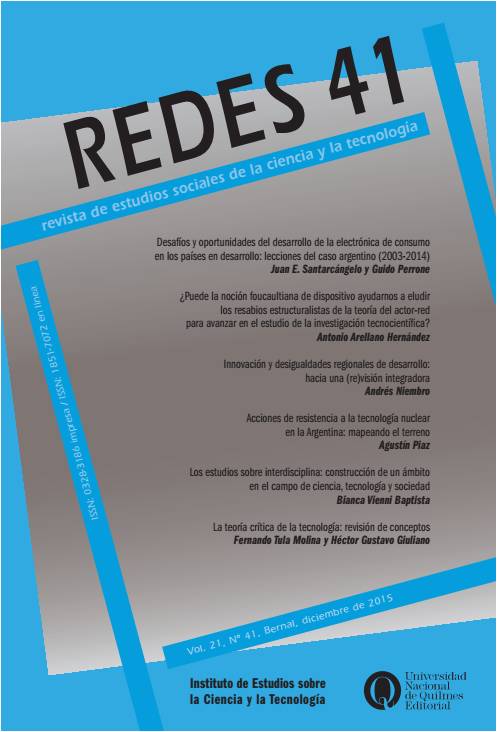
Innovación y desigualdades regionales de desarrollo: hacia una (re)visión integradora
DOI:
https://doi.org/10.48160/18517072re41.604Palabras clave:
sistemas de innovación, desarrollo regional, desigualdad, path-dependenceResumen
Aunque en tiempos de la globalización pueda resultar un tanto paradójico, en los últimos años se ha venido evidenciando un interés creciente en las regiones como horizonte de análisis, en la problemática de las desigualdades regionales de desarrollo y en el rol de la innovación a la hora de dar cuenta de dichas disparidades. No obstante, todavía restan importantes nichos para profundizar en las vinculaciones entre estos tópicos. El objetivo del presente trabajo es aportar una primera revisión teórica y balance integrador de la literatura que se ha venido ocupando –aunque muchas veces de un modo parcial– de las relaciones entre innovación, desigualdades o desarrollo regional. Si algo sobresale de esta tarea es que estamos frente a un fenómeno complejo, multidimencional y de muy difícil simplificación, en el cual se entretejen interacciones cruzadas entre todas sus diferentes partes.
Citas
Aghion, P. y P. Howitt (1992), “A model of growth through creative destruction”, Econometrica, vol. 60, Nº 2, pp. 323-351.
Albuquerque, E. M. (2007), “Inadequacy of technology and innovation systems at the periphery”, Cambridge Journal of Economics, vol. 31, Nº 5, pp. 669-690.
Altenburg, T. (2009), “Building inclusive innovation systems in developing countries: Challenges for is research”, en Lundvall, B.-Å., K. J. Joseph, C. Chaminade y J. Vang (eds.), Handbook of Innovation Systems and Developing Countries, Cheltenham/Northampton, Edward Elgar.
Amin, A. y N. Thrift (1994), “Living in the global”, en Amin, A. y N. Thrift (eds.), Globalisation, institutions and regional development in Europe, Oxford, Oxford University Press.
Andersen, E. S. (1992), “Approaching national systems of innovation from the production and linkage structure”, en Lundvall, B.-Å. (ed.), National systems of innovation. Towards a theory of innovation and interactive learning, Londres, Pinter Publishers.
Antonelli, C. (2008), Localised technological change: Towards the economics of complexity, Londres/Nueva York, Routledge.
Antonelli, C. (2014), “La complejidad económica del conocimiento tecnológico, la innovación y el cambio estructural”, en Barletta, F., V. Robert y G. Yoguel (eds.), Tópicos de la teoría evolucionista neoschumpeteriana de la innovación y el cambio tecnológico, vol. 1, Buenos Aires, ungs/Miño Dávila.
Archibugi, D. y C. Pietrobelli (2003), “The globalisation of technology and its implications for developing countries: Windows of opportunity or further burden?”, Technological Forecasting and Social Change, vol. 70, Nº 9, pp. 861-883.
Arocena, R. y P. Senker (2003), “Technology, inequality, and underdevelopment: The case of Latin America”, Science, Technology & Human Values, vol. 28, Nº 1, pp. 15-33.
Arocena, R. y J. Sutz (2000), “Looking at national systems of innovation from the South”, Industry and Innovation, vol. 7, Nº 1, pp. 55-75.
Arocena, R. y J. Sutz (2003), “Inequality and innovation as seen from the South”, Technology in Society, vol. 25, Nº 2, pp. 171-182.
Arocena, R. y J. Sutz (2012), “Research and innovation policies for social inclusion: An opportunity for developing countries”, Innovation and Development, vol. 2, Nº 1, pp. 147-158.
Arthur, W. B. (1988), “Self-reinforcing mechanisms in economics”, en Anderson, P., K. Arrow y D. Pines (eds.), The economy as an evolving, complex system, Reading, Addison-Wesley.
Arthur, W. B. (1989), “Competing technologies, increasing returns, and lock-in by historical events”, The Economic Journal, vol. 99, Nº 394, pp. 116-131.
Ascani, A., R. Crescenzi y S. Iammarino (2012), “Regional economic development: A review”, search Working Paper, Nº 01/03, Project Sharing Knowledge Assets: InteRregionally Cohesive NeigHborhoods (search).
Asheim, B. (1996), “Industrial districts as ‘learning regions’: A condition for prosperity”, European Planning Studies, vol. 4, Nº 4, pp. 379-400.
Asheim, B. (2007), “Differentiated knowledge bases and varieties of regional innovation systems”, Innovation, vol. 20, Nº 3, pp. 223-241.
Asheim, B. y L. Coenen (2005), “Knowledge bases and regional innovation systems: Comparing Nordic clusters”, Research Policy, vol. 34, Nº 8, pp. 1173-1190.
Asheim, B. y M. Gertler (2005), “The geography of innovation: Regional innovation systems”, en Fagerberg, J., D. Mowery y R. Nelson (eds.), The Oxford handbook of innovation, Oxford, Oxford University Press.
Asheim, B. y A. Isaksen (1997), “Location, agglomeration and innovation: Towards regional innovation systems in Norway?”, European Planning Studies, vol. 5, Nº 3, pp. 299-330.
Asheim, B., H. Lawton Smith y C. Oughton (2011), “Regional innovation systems: Theory, empirics and policy”, Regional Studies, vol. 45, Nº 7, pp. 875-891.
Audretsch, B. (1998), “Agglomeration and the location of innovative activity”, Oxford Review of Economic Policy, vol. 14, Nº 2, pp. 18-29.
Aydalot, P. (ed.) (1986), Milieux innovateurs in Europe, París, gremi (Groupe de Recherche Européen sur les Milieux Innovateurs).
Baptista, R. y P. Swann (1998), “Do firms in clusters innovate more?”, Research Policy, vol. 27, Nº 5, pp. 525-540.
Barletta, F., V. Robert y G. Yoguel (2014), “Introducción: Tópicos de la teoría evolucionista neoschumpeteriana de la innovación y el cambio tecnológico”, en Barletta, F., V. Robert y G. Yoguel (eds.), Tópicos de la teoría evolucionista neoschumpeteriana de la innovación y el cambio tecnológico, vol. 1, Buenos Aires, ungs/Miño Dávila.
Barros, A. (2011), Desigualdades regionais no Brasil: Natureza, causas, origens e soluções, Río de Janeiro, Elsevier.
Bathelt, H. y J. Boggs (2003), “Toward a reconceptualization of regional development paths: Is Leipzig’s media cluster a continuation of or a rupture with the past?”, Economic Geography, vol. 79, Nº 3, pp. 265-293.
Bathelt, H., A. Malmberg y P. Maskell (2004), “Clusters and knowledge: Local buzz, global pipelines and the process of knowledge creation”, Progress in Human Geography, vol. 28, Nº 1, pp. 31-56.
Becattini, G. (ed.) (1987), Mercato e forze locali: Il distretto industriale, Bolonia, Il Mulino.
Benneworth, P. y A. Dassen (2011), “Strengthening global-local connectivity in regional innovation strategies: Implications for regional innovation policy”, oecd Regional Development, Working Paper Nº 2011/01, oecd Publishing.
Berumen, S. (2008), “Una aproximación a la construcción del pensamiento neoshumpeteriano: Más allá del debate entre ortodoxos y heterodoxos”, ice. Revista de Economía, Nº 845, pp. 135-146.
Boschma, R. (2005), “Proximity and innovation: A critical assessment”, Regional Studies, vol. 39, Nº 1, pp. 61-74.
Boschma, R. y Frenken K. (2003), “Evolutionary economics and industry location”, International Review for Regional Research, vol. 23, pp. 183-200.
Boschma, R. y R. Martin (2007), “Editorial: Constructing an evolutionary economic geography”, Journal of Economic Geography, vol. 7, Nº 5, pp. 537-549.
Boschma, R. y R. Martin (2010) (ed.), Handbook of evolutionary economic geography, Cheltenham/ Northampton, Edward Elgar.
Boschma, R. y G. van der Knaap (1997), “New technology and windows of locational opportunity”, en Reijnders, J. (ed.), Economics and evolution, Cheltenham, Edward Elgar.
Braczyk, H. J., P. Cooke y M. Heidenreich (eds.) (1998), Regional innovation systems: The role of governance in a globalized world, Londres, ucl Press.
Breschi, S. y F. Malerba (1997), “Sectoral innovation systems: Technological regimes, schumpeterian dynamics and spatial boundaries”, en Edquist, C. (ed.), Systems of innovation: Technologies, institutions and organizations, Londres, Pinter Publishers.
Breschi, S. y L. Orsenigo (2000), “Technological regimes and schumpeterian patterns of innovation”, The Economic Journal, vol. 110, Nº 463, pp. 388-410.
Brown, J. S. y P. Duguid (1991), “Organizational learning and communities-of-practice: Towards a unified view of working, learning, and innovation”, Organization Science, vol. 2, Nº 1, pp. 40-57.
Cairncross, A. (1997), The death of distance, Boston, Harvard University Press.
Camagni, R. (1991), “Local ‘milieu’, uncertainty and innovation networks: Towards a new dynamic theory of economic space”, en Camagni, R. (ed.), Innovation networks: Spatial perspectives, Londres, Belhaven.
Camagni, R. (1995), “The concept of innovative milieu and its relevance for public policies in European lagging regions”, Papers in Regional Science, vol. 74, Nº 4, pp. 317-340.
Carlsson, B. (2006), “Internationalization of innovation systems: A survey of the literature”, Research Policy, vol. 35, Nº 1, pp. 56-67.
Carlsson, B. y S. Jacobsson (1997), “Diversity creation and technological systems: A technology policy perspective”, en Edquist, C. (ed.), Systems of innovation: Technologies, institutions and organizations, Londres, Pinter Publishers.
Carlsson, B. y R. Stankiewicz (1991), “On the nature, function and composition of technological systems”, Journal of Evolutionary Economics, vol. 1, Nº 2, pp. 93-118.
Cassiolato, J. E. y H. Lastres (2008), “Discussing innovation and development: Converging points between the Latin American school and the innovation systems perspective”, Globelics Working Paper Nº 2008-02.
Cassiolato, J. E., M. Matos y H. Lastres (2014), “Innovation systems and development”, en Currie-Alder, B., R. Kanbur, D. M. Malone y R. Medhora (eds.), International development ideas, experience, and prospects, Oxford, Oxford University Press.
Cassiolato, J. E. y M. C. C. Soares (2014), “Introduction: brics national systems of innovation”, en Soares, M. C. C., M. Scerri y R. Maharajh (eds.), Inequality and development challenges, Nueva Delhi/Londres, Routledge.
cepal (2010), La hora de la igualdad. Brechas por cerrar, caminos por abrir, Santiago de Chile, cepal.
Chataway, J., R. Hanlin y R. Kaplinsky (2014), “Inclusive innovation: An architecture for policy development”, Innovation and Development, vol. 4, Nº 1, pp. 33-54.
Chiaromonte, F. y G. Dosi (1993), “Heterogeneity, competition, and macroeconomic dynamics”, Structural Change and Economic Dynamics, vol. 4, Nº 1, pp. 39-63.
Cimoli, M. (ed.) (2005), Heterogeneidad estructural, asimetrías tecnológicas y crecimiento en América Latina, Santiago de Chile, cepal.
Cimoli, M. y J. Katz (2003), “Structural reforms, technological gaps and economic development. A Latin American perspective”, Industrial and Corporate Change, vol. 12, Nº 2, pp. 387-411.
Coenen, L. y B. Asheim (2006), “Constructing regional advantage at the Northern edge”, en Cooke, P. y A. Piccaluga (eds.), Regional development in the knowledge economy, Londres/Nueva York, Routledge.
Cohen, W. y D. Levinthal (1990), “Absorptive capacity: A new perspective on learning and innovation”, Administrative Science Quarterly, vol. 35, Nº 1, pp. 128-152.
Cooke, P. (1992), “Regional innovation systems: Competitive regulation in the new Europe”, Geoforum, vol. 23, Nº 3, pp. 365-382.
Cooke, P. (1998), “Introduction: Origins of the concept”, en Braczyk, H. J., P. Cookey y M. Heidenreich (eds.), Regional innovation systems: The role of governance in a globalized worl, Londres, ucl Press.
Cooke, P. (2001), “Regional innovation systems, clusters, and the knowledge economy”, Industrial and Corporate Change, vol. 10, Nº 4, pp. 945-974.
Cooke, P. (2004), “Introduction: Regional innovation systems – an evolutionary approach”, en Cooke, P., M. Heidenreich y H. J. Braczyk (eds.), Regional innovation systems: The role of governance in a globalized world, 2ª ed., Londres/Nueva York, Routledge.
Cooke, P. y K. Morgan (1998), The associational economy: Firms, regions, and innovation, Oxford, Oxford University Press.
Cooke, P., M. G. Uranga y G. Etxebarria (1997), “Regional innovation systems: Institutional and organisational dimensions”, Research Policy, vol. 26, Nº 4, pp. 475-491.
Cozzens, S. y R. Kaplinsky (2009), “Innovation, poverty and inequality. Cause, coincidence, or co-evolution”, en Lundvall, B.-Å., K. J. Joseph, C. Chaminade y J. Vang (eds.), Handbook of Innovation Systems and Developing Countries, Cheltenham/Northampton, Edward Elgar.
Cuadrado-Roura, J. R. y P. Aroca (2013) (eds.), Regional Problems and Policies in Latin America, Nueva York, Springer.
David, P. A. (1985), “Clio and the economics of qwerty”, The American Economic Review, vol. 75, Nº 2, pp. 332-337.
David, P. A. (1986), “Understanding the economics of qwerty: The necessity of history”, en Parket, W. N. (ed.), Economic history and the modern economics, Oxford, Blackwell.
De la Mothe, J. y G. Paquet (eds.) (1998), Local and regional systems of innovation, Boston, Kluwer Academic Publishers.
Dicken, P. (2011), Global shift: Mapping the changing contours of the world economy, 6ª ed., Nueva York, The Guilford Press.
Doloreux, D. (2002), “What we should know about regional systems of innovation”, Technology in Society, vol. 24, Nº 3, pp. 243-263.
Doloreux, D. y S. Parto (2005), Regional innovation systems: Current discourse and unresolved issues, Technology in Society, vol. 27, Nº 2, pp. 133-153.
Dosi, G. (1982), “Technological paradigms and technological trajectories: A suggested interpretation of the determinants and directions of technical change”, Research Policy, vol. 11, Nº 3, pp. 147-162.
Dosi, G. (1984), “Technological paradigms and technological trajectories: The determinants and directions of technical change and the transformation of the economy”, en Freeman, C. (ed.), Long waves in the world economy, Londres, Butterworth.
Dosi, G. (1988), “The nature of the innovative process”, en Dosi, G., C. Freeman, R. Nelson y L. Soete (eds.), Technical change and economic theory, Londres, Printer.
Dosi, G., C. Freeman y S. Fabiani (1994), “The process of economic development: Introducing some stylized facts and theories on technologies, firms and institutions”, Industrial and Corporate Change, vol. 3, Nº 1, pp. 1-45.
Dutrénit, G., J. C. Moreno-Brid y M. Puchet Anyul (2013), “Crecimiento económico, innovación y desigualdad en América Latina: avances, retrocesos y pendientes post Consenso de Washington”, en Dutrénit, G. y J. Sutz (eds.), Sistemas de innovación para un desarrollo inclusivo. La experiencia latinoamericana, México, Foro Consultivo Científico y Tecnológico, AC/ lalics.
Dutrénit, G. y J. Sutz (2014), “Introduction to national innovation systems, social inclusion and development”, en Dutrénit, G. y J. Sutz (eds.), National innovation systems, social inclusion and development: The Latin American experience, Cheltenham/Northampton, Edward Elgar.
Edquist, C. (1997a), “Systems of innovation approaches - their emergence and characteristics”, en Edquist, C. (ed.), Systems of innovation: Technologies, institutions and organizations, Londres, Pinter Publishers.
Edquist, C. (ed.) (1997b), Systems of innovation: Technologies, institutions and organizations, Londres, Pinter Publishers.
Edquist, C. (2005), “Systems of innovation: Perspectives and challenges”, en Fagerberg, J., D. Mowery y R. Nelson (eds.), The Oxford handbook of innovation, Oxford, Oxford University Press.
Etzkowitz, H. y L. Leydesdorff (1997), Universities in the Global Economy: A Triple Helix of Government–Industry and Government Relations, Londres, Croom Helm.
Fagerberg, J., M. Srholec y B. Verspagen (2010), “Innovation and economic development”, en Hall, B. y N. Rosenberg (eds.), Handbook of the economics of innovation, vol. 2, Amsterdam, Elsevier.
Florida, R. (1995), “Toward the learning region”, Futures, vol. 27, Nº 5, pp. 527-536.
Foster, C. y R. Heeks (2013), “Conceptualising inclusive innovation: Modifying systems of innovation frameworks to understand diffusion of new technology to low-income consumers”, European Journal of Development Research, vol. 25, Nº 3, pp. 333-355.
Fratesi, U. (2007), “The Spatial Diffusion of Innovations and the Evolution of Regional Disparities”, Investigaciones Regionales, Nº 11, pp. 131-160.
Freeman, C. (1987), Technology policy and economic performance: Lessons from Japan, Londres, Pinter Publishers.
Freeman, C. (1995), “The ‘national system of innovation’ in historical perspective”, Cambridge Journal of Economics, vol. 19, Nº 1, pp. 5-24.
Freeman, C. (2002), “Continental, national and sub-national innovation systems – Complementarity and economic growth”, Research Policy, vol. 31, Nº 2, pp. 191-211.
Fujita, M., P. Krugman y A. Venables (1999), The spatial economy: Cities, regions, and international trade, Cambridge, mit Press.
Galvis, L. A. y A. Meisel Roca (2010), “Persistencia de las desigualdades regionales en Colombia. Un análisis espacial”, Documentos de Trabajo sobre Economía Regional, Nº 120, Cartagena, Centro de Estudios Económicos Regionales, Banco de la República.
Gertler, M. (2003), “Tacit knowledge and the economic geography of context, or the undefinable tacitness of being (there)”, Journal of Economic Geography, vol. 3, Nº 1, pp. 75-99.
Gertler, M. (2005), “Tacit knowledge, path dependency and local trajectories of growth”, en Fuchs, G. y P. Shapira (eds.), Rethinking regional innovation and change: Path dependency or regional breakthrough, Boston, Springer.
Grabher, G. (1993), “The weakness of strong ties: The lock-in of regional development in the Ruhr-area”, en Grabher, G. (ed.), The embedded firm: On the socioeconomics of industrial networks, Londres/Nueva York, Routledge.
Griliches, Z. (1979), “Issues in assessing the contribution of research and development to productivity growth”, The Bell Journal of Economics, vol. 10, Nº 1, pp. 92-116.
Grossman, M. y E. Helpman (1994), “Endogenous innovation in the theory of growth”, Journal of Economic Perspectives, vol. 8, Nº 1, pp. 23-44.
Harvey, D. (1982), The Limits to Capital, Oxford, Blackwell.
Hassink, R. (2005), “How to unlock regional economies from path dependency? From learning region to learning cluster”, European Planning Studies, vol. 13, Nº 4, pp. 521-535.
Heidenreich, M. y C. Wunder (2008), “Patterns of regional inequality in the enlarged Europe”, European Sociological Review, vol. 24, Nº 1, pp. 19-36.
Howells, J. (2002), “Tacit knowledge, innovation and economic geography”, Urban Studies, vol. 39, Nos 5-6, pp. 871-884.
Howells, J. (2005), “Innovation and regional economic development: A matter of perspective?”, Research Policy, vol. 34, Nº 8, pp. 1220-1234.
Hudson, R. (2007), “Regions and regional uneven development forever? Some reflective comments upon theory and practice”, Regional Studies, vol. 41, Nº 9, pp. 1149-1160.
Iammarino, S. (2005), “An evolutionary integrated view of regional systems of innovation: Concepts, measures and historical perspectives”, European Planning Studies, vol. 13, Nº 4, pp. 497-519.
Isaksen, A. y M. Trippl (2014), “Regional industrial path development in different regional innovation systems: A conceptual analysis”, Papers in Innovation Studies, Nº 2014/17, Centre for Innovation, Research and Competence in the Learning Economy, Lund University.
Jimenez, F., I. Fernández y A. Menéndez (2011), “Los sistemas regionales de innovación: Revisión conceptual e implicaciones en América Latina”, en Llisterri, J. J. y C. Pietrobelli (eds.), Los sistemas regionales de innovación en América Latina, Washington, Banco Interamericano de Desarrollo.
Johnson, B. (1992), “Institutional learning”, en Lundvall, B.-Å. (ed.), National systems of innovation. Towards a theory of innovation and interactive learning, Londres, Pinter Publishers.
Johnson, B., C. Edquist y B.-Å. Lundvall (2003), “Economic development and the national system of innovation approach”, I Globelics International Conference, Río de Janeiro, 3-6 de noviembre.
Johnson, B. y B.-Å. Lundvall (2000), “Promoting innovation systems as a response to the globalising learning economy”, Nota Técnica Nº 4, proyecto “Arranjos e sistemas produtivos locais e as novas políticas de desenvolvimento industrial e tecnológico”, Río de Janeiro, Instituto de Economia da Universidade Federal do Rio de Janeiro.
Jorgenson, D. W. y Z. Griliches (1967), “The explanation of productivity change”, The Review of Economic Studies, vol. 34, Nº 3, pp. 249-283.
Kanbur, R., L. F. López Calva y A. Venables (2005), “Symposium on spatial inequality in Latin America”, Cuadernos de Economía, Nº 42, mayo, pp. 133-136.
Kanbur, R. y A. Venables (2005), “Spatial inequality and development”, en Kanbur, R. y A. Venables (eds.), Spatial inequality and development, Oxford, Oxford University Press.
Kanbur, R., A. Venables y G. Wan (2006), Spatial disparities in human development: Perspectives from Asia, United Nations University Press.
Katz, J. (2006), “Cambio estructural y capacidad tecnológica local”, Revista de la cepal, Nº 89, pp. 59-73.
Kaufmann, A. y F. Tödtling (2000), “Systems of innovation in traditional industrial regions: The case of Styria in a comparative perspective”, Regional Studies, vol. 34, Nº 1, pp. 29-40.
Kessler, G. (2014), Controversias sobre la desigualdad: Argentina, 2003-2013, Buenos Aires, Fondo de Cultura Económica.
Kim, S. (2009), “Spatial inequality and economic development: Theories, facts, and policies”, en Spence, M., P. Clarke y R. Buckley (eds.), Urbanization and growth, Washington, Banco Mundial.
Lagendijk, A. y A. Lorentzen (2007), “Proximity, knowledge and innovation in peripheral regions: On the intersection between geographical and organizational proximity”, European Planning Studies, vol. 15, Nº 4, pp. 457-466.
Lee, N. y A. Rodríguez-Pose (2013), “Innovation and spatial inequality in Europe and usa”, Journal of Economic Geography, vol. 13, Nº 1, pp. 1-22.
Leydesdorff, L. (2000), “The triple helix: An evolutionary model of innovations”, Research Policy, vol. 29, Nº 2, pp. 243-255.
López, A. (1998), “La reciente literatura sobre la economía del cambio tecnológico y la innovación. Una guía temática”, i&d. Revista de Industria y Desarrollo, vol. 1, Nº 3, pp. 105-156.
López, A. (2007), Desarrollo económico y sistema nacional de innovación en la Argentina. El caso argentino desde 1860 hasta 2001, Buenos Aires, edicon.
López, A., A. Niembro y D. Ramos (2011), “Cadenas globales de valor en el sector servicios. Estrategias empresarias e inserción de los países de América Latina”, Integración y Comercio, vol. 15, Nº 32, pp. 57-68.
López, A. (2013), “Cadenas globales de valor, offshoring de servicios y rol de los recursos humanos. Lecciones de la Argentina”, en Suárez, D. (ed.), El sistema argentino de innovación: instituciones, empresas y redes. El desafío de la creación y apropiación de conocimiento, Buenos Aires, ungs.
López, A. (2014), “La competitividad de América Latina en el comercio de servicios basados en el conocimiento”, Revista de la cepal, Nº 113, pp. 23-41.
Lundvall, B.-Å. (1988), “Innovation as an interactive process: From user-producer interaction to the national systems of innovation”, en Dosi, G., C. Freeman, R. Nelson y L. Soete (eds.), Technical change and economic theory, Londres, Printer.
Lundvall, B.-Å. (1992a), “Introduction”, en Lundvall, B.-Å. (ed.), National systems of innovation. Towards a theory of innovation and interactive learning, Londres, Pinter Publishers.
Lundvall, B.-Å. (1992b), “User-producer relationships, national systems of innovation and internationalisation”, en Lundvall, B.-Å. (ed.), National systems of innovation. Towards a theory of innovation and interactive learning, Londres, Pinter Publishers.
Lundvall, B.-Å. (ed.) (1992c), National systems of innovation. Towards a theory of innovation and interactive learning, Londres, Pinter Publishers.
Lundvall, B.-Å. (2010), “Post script: Innovation system research – Where it came from and where it might go”, en Lundvall, B.-Å. (ed.), National systems of innovation. Towards a theory of innovation and interactive learning, Londres/ Nueva York, Anthem Press.
Lundvall, B.-Å. y S. Borrás (1997), “The globalising learning economy: Implications for innovation policy”, Project Report under the tser Programme, dg xii, Commission of the European Union.
Lundvall, B.-Å., B. Johnson, E. S. Andersen y B. Dalum (2002), “National systems of production, innovation and competence building”, Research Policy, vol. 31, Nº 2, pp. 213-231.
Lundvall, B.-Å., J. Vang, K. J. Joseph y C. Chaminade (2009), “Innovation system research and developing countries”, en Lundvall, B.-Å., K. J. Joseph, C. Chaminade y J. Vang (eds.), Handbook of Innovation Systems and Developing Countries, Cheltenham/Northampton, Edward Elgar.
MacKinnon, D. y A. Cumbers (2007), An introduction to economic geography: Globalization, uneven development and place, Harlow, Pearson Education.
MacKinnon, D., A. Cumbers y K. Chapman (2002), “Learning, innovation and regional development: A critical appraisal of recent debates”, Progress in Human Geography, vol. 26, Nº 3, pp. 293-311.
Malerba, F. (2002), “Sectoral systems of innovation and production”, Research Policy, vol. 31, Nº 2, pp. 247-264.
Malerba, F. (ed.) (2004), Sectoral systems of innovation: Concepts, issues and analyses of six major sectors in Europe, Cambridge, Cambridge University Press.
Malerba, F. (2005), “Sectoral systems: How and why innovation differs across sectors”, en Fagerberg, J., D. Mowery y R. Nelson (ed.), The Oxford handbook of innovation, Oxford, Oxford University Press.
Malerba, F. y S. Mani (eds.) (2009), Sectoral systems of innovation and production in developing countries, Cheltenham/Northampton, Edward Elgar.
Malerba, F. y L. Orsenigo (1990), “Technological regimes and patterns of innovation: A theoretical and empirical investigation of the Italian case”, en Heertje, A. (ed.), Evolving industries and market structures, Ann Arbor, University of Michigan Press.
Malerba, F. y L. Orsenigo (1993), “Technological regimes and firm bebavior”, Industrial and Corporate Change, vol. 2, Nº 1, pp. 45-71.
Malerba, F. y L. Orsenigo (1997), “Technological regimes and sectoral patterns of innovative activities”, Industrial and Corporate Change, vol. 6, Nº 1, pp. 83-118.
Malmberg, A. y P. Maskell (2006), “Localized learning revisited”, Growth and Change, vol. 37, Nº 1, pp. 1-18.
Markusen, A. (1996), “Sticky places in slippery space: A typology of industrial districts”, Economic Geography, vol. 72, Nº 3, pp. 293-313.
Marsili, O. (2001), The anatomy and evolution of industries: Technological change and industrial dynamics, Cheltenham/Northampton, Edward Elgar.
Martin, R. (2010), “Roepke lecture in economic geography – Rethinking regional path dependence: Beyond lock-in to evolution”, Economic Geography, vol. 86, Nº 1, pp. 1-27.
Martin, R. y J. Simmie (2008), “Path dependence and local innovation systems in city-regions”, Innovation: Management, Policy & Practice, vol. 10, Nos 2-3, pp. 183-196.
Martin, R. y P. Sunley (2006), “Path dependence and regional economic evolution”, Journal of Economic Geography, vol. 6, Nº 4, pp. 395-437.
Martin, R. y P. Sunley (2010), “The place of path dependence in an evolutionary perspective on the economic landscape”, en Boschma, R. y R. Martin (eds.), Handbook of evolutionary economic geography, Cheltenham/Northampton, Edward Elgar.
Maskell, P., H. Eskelinen, I. Hannibalsson, A. Malmberg y E. Varne (1998), Competitiveness, localised learning and regional development: Specialisation and prosperity in small open economies, Londres, Routledge.
Maskell, P. y A. Malmberg (1999a), “The competitiveness of firms and regions – ‘Ubiquitification’ and the importance of localized learning”, European Urban and Regional Studies, vol. 6, Nº 1, pp. 9-25.
Maskell, P. y A. Malmberg (1999b), “Localised learning and industrial competitiveness”, Cambridge Journal of Economics, vol. 23, Nº 2, pp. 167-185.
Massey, D. (1984), Spatial divisions of labour: Social structures and the geography of production, Londres, Macmillan.
Metcalfe, J. S. (2010), “Complexity and emergence in economics: The road from Smith to Hayek (via Marshall and Schumpeter)”, History of Economic Ideas, vol. xviii, pp. 45-75.
Milanovic, B. (2005), “Half a world: Regional inequality in five great federations”, Journal of the Asia Pacific Economy, vol. 10, Nº 4, pp. 408-445.
Monfort, P. (2009), “Regional convergence, growth and interpersonal inequalities across EU”, Report Working Paper of Directorate General Regional Policy European Commission.
Morgan, K. (1997), “The learning region: Institutions, innovation and regional renewal”, Regional Studies, vol. 31, Nº 5, pp. 491-503.
Morgan, K. (2004a), “The exaggerated death of geography: Learning, proximity and territorial innovation systems”, Journal of Economic Geography, vol. 4, Nº 1, pp. 3-21.
Morgan, K. (2004b), “Sustainable regions: Governance, innovation and scale”, European Planning Studies, 12, (6), pp. 871-89.
Navarro, M. (2009), “Los sistemas regionales de innovación. Una revisión crítica”, Ekonomiaz, vol. 70, Nº 1, pp. 25-59.
Navarro, M. y J. J. Gibaja (2009), “Las tipologías en los sistemas regionales de innovación. El caso de España”, Ekonomiaz, vol. 70, Nº 1, pp. 240-281.
Nelson, R. (ed.) (1993), National innovation systems. A comparative analysis, Nueva York, Oxford University Press.
Nelson, R. y S. Winter (1982), An evolutionary theory of economic change, Cambridge, Harvard University Press.
Niembro, A. (2013), “Brechas de desarrollo regional y provincial en argentina: Hacia una nueva forma de medición y un análisis de su evolución en los años 2000”, Anales de las XLVIII Jornadas de la aaep, Rosario.
Niembro, A. (2015), “Las brechas territoriales del desarrollo argentino. Un balance (crítico) de los años 2000”, Desarrollo Económico, vol. 55, Nº 215, mayo-agosto, Buenos Aires, ides.
Niosi, J. y B. Bellon (1994), “The global interdependence of national innovation systems: Evidence, limits, and implications”, Technology in Society, vol. 16, Nº 2, pp. 173-197.
Niosi, J. y B. Bellon (1996), “The globalization of national innovation systems”, en De la Mothe, J. y G. Paquet (eds.), Evolutionary economics and the new international political economy, Nueva York, Pinter Publishers.
Nonaka, I. y H. Takeuchi (1995), The knowledge-creating company: How Japanese companies create the dynamics of innovation, Oxford, Oxford University Press.
O’Brien, R. (1992), Global financial integration: The end of geography, Londres, Pinter Publishers.
Ocampo, J. A. (2005), “The quest for dynamic efficiency: Structural dynamics and economic growth in developing countries”, en Ocampo, J. A. (ed.), Beyond reforms: Structural dynamics and macroeconomic vulnerability, Washington, Stanford University Press/cepal/Banco Mundial.
Ordóñez Tovar, J. A. (2015), “Desigualdades regionales en México: la importancia de considerar las capacidades regionales para el diseño de la política de desarrollo regional”, Circunstancia, año xiii, Nº 36, enero, pp. 1-17.
Oyelaran-Oyeyinka, O. y R. Rasiah (2009), Uneven paths of development: Innovation and learning in Asia and Africa, Cheltenham/Northampton, Edward Elgar.
Papaioannou, T. (2014), “How inclusive can innovation and development be in the twenty-first century?”, Innovation and Development, vol. 4, Nº 2, pp. 187-202.
Pavitt, K. (1984), “Sectoral patterns of technical change: Towards a taxonomy and a theory”, Research Policy, vol. 13, Nº 6, pp. 343-373.
Pavitt, K. y P. Patel (1999), “Global corporations and national systems of innovation: Who dominates whom?”, en Archibugi, D., J. Howells y J. Michie (eds.), Innovation policy in a global economy, Cambridge, Cambridge University Press.
Perrons, D. (2004), Globalization and social change: People and places in a divided world, Londres, Routledge.
Perrons, D. (2011), “Regional disparities and equalities: Towards a capabilities perspective?”, en Pike, A., A. Rodríguez-Pose y J. Tomaney (eds.), Handbook of local and regional development, Londres/Nueva York, Routledge.
Pike, A., A. Rodríguez-Pose y J. Tomaney (2006), Local and regional development, Londres/Nueva York, Routledge.
Pike, A., A. Rodríguez-Pose y J. Tomaney (2007), “What kind of local and regional development and for whom?”, Regional Studies, vol. 41, Nº 9, pp. 1253-1269.
Piore, M. y C. Sabel (1984), The second industrial divide: Possibilities for prosperity, Nueva York, Basic Books.
PNUD (1990), Human development report 1990, Nueva York, Oxford University Press.
Polanyi, M. (1966), The tacit dimension, Londres, Routledge & Kegan Paul.
Porter, M. (1998), “Clusters and the new economics of competition”, Harvard Business Review, noviembre-diciembre, pp. 77-90.
Porter, M. (2000), “Location, competition, and economic development: Local clusters in a global economy”, Economic Development Quarterly, vol. 14, Nº 1, pp. 15-34.
Pyke, F., G. Becattini y W. Sengenberger (eds.) (1990), Industrial districts and inter-firm co-operation in italy, Génova, International Institute for Labour Studies.
Reinert, E. (1996), “The role of technology in the creation of rich and poor nations: Underdevelopment in a schumpeterian system”, en Aldcroft, D. H. y R. Catterall (eds.), Rich nations - poor nations: The long run perspective, Cheltenham/Northampton, Edward Elgar.
Reinert, E. (2004), “Introduction”, en Reinert, E. (ed.), Globalization, economic development and inequality, Cheltenham/Northampton, Edward Elgar.
rimisp (2012), Pobreza y desigualdad. Informe latinoamericano 2011, Santiago de Chile, rimisp-Centro Latinoamericano para el Desarrollo Rural.
Robert, V. (2012), “Interacciones, feedbacks y externalidades: la micro complejidad de los sistemas productivos y de innovación locales. Una aproximación en pymes argentinas”, tesis doctoral, Facultad de Ciencias Económicas, Universidad de Buenos Aires.
Robert, V. y Yoguel G. (2010), “La dinámica compleja de la innovación y el desarrollo económico”, Desarrollo Económico, vol. 50, Nº 199, pp. 423-453.
Rogers, E. M. (1995), Diffusion of innovations, Nueva York, Free Press.
Romer, P. (1990), “Endogenous technological change”, Journal of Political Economy, vol. 98, Nº 5, pp. 71-102.
Sanabria Gómez, S. A. (2013), “Asimetrías tecnológicas y desequilibrios económicos regionales. Una aproximación teórica”, Revista de Estudios Regionales, Nº 98, pp. 131-154.
Sastré Gutiérrez, M. y S. Rey (2008), “Polarización espacial y dinámicas de la desigualdad interregional en México”, Problemas del Desarrollo, vol. 39, Nº 155, pp. 181-204.
Saxenian, A. (1994), Regional advantage: Culture and competition in Silicon Valley and Route 128, Cambridge, Harvard University Press.
Scerri, M., M. C. C. Soares y R. Maharajh (2014), “The co-evolution of innovation and inequality”, en Soares, M. C. C., M. Scerri y R. Maharajh (eds.), Inequality and development challenges, Nueva Delhi/Londres, Routledge.
Scott, A. (1996), “Regional motors of the global economy”, Futures, vol. 28, Nº 5, pp. 391-411.
Scott, A. (2006), Geography and economy, Oxford, Oxford University Press.
Scott, A. y G. Garofoli (2007), “The regional question in economic development”, en Scott, A. y G. Garofoli (eds.), Development on the ground: Clusters, networks and regions in emerging economies, Londres/Nueva York, Routledge.
Scott, A. y M. Storper (2003), “Regions, globalization, development”, Regional Studies, vol. 37, Nos 6-7, pp. 549-578.
Schumpeter, J. (1934), The theory of economic development: An inquiry into profits, capital, credit, interest, and the business cycle, Cambridge, Harvard University Press.
Schumpeter, J. (1942), Capitalism, socialism and democracy, Londres, Allen & Unwin.
Sen, A. (2000), Desarrollo y libertad, Barcelona, Planeta.
Silva Lira, I. (2012), “El lugar importa: Desarrollo regional en América Latina”, en Ross, K. y L. Riffo (eds.), Desarrollo regional en América Latina. El lugar importa, Santiago de Chile, cepal/ilpes.
Silverberg, G. y B. Verspagen (1994), “Learning, innovation and economic growth: A long-run model of industrial dynamics”, Industrial and Corporate Change, vol. 3, Nº 1, pp. 199-223.
Simmie, J. (2013), “Path dependence and new technological path creation in the economic landscape”, en Cooke, P. (ed.), Re-framing regional development: Evolution, innovation and transition, Londres/Nueva York, Routledge.
Soares, M. C. C. y J. E. Cassiolato (2008), “Innovation systems and inequality: The experience of Brazil”, VI Globelics International Conference, 22-24 de septiembre, México.
Soares, M. C. C. y J. E. Cassiolato (2013), “Innovation systems and inclusive development: Some evidence based on empirical work”, dsa Information, Technology and Development Study Group Meeting: “New Models of Innovation for Development”, 4-5 de julio, University of Manchester.
Solow, R. (1956), “A contribution to the theory of economic growth”, Quarterly Journal of Economics, vol. 70, Nº 1, pp. 65-94.
Storper, M. (1995), “The resurgence of regional economies, ten years later: The region as a nexus of untraded interdependencies”, European Urban and Regional Studies, vol. 2, Nº 3, pp. 191-221.
Storper, M. (1997), The regional world: Territorial development in a global economy, Londres, Guilford Press.
Storper, M. y A. Venables (2004), “Buzz: Face-to-face contact and the urban economy”, Journal of Economic Geography, vol. 4, Nº 4, pp. 351-370.
Storper, M. y R. Walker (1989), The capitalist imperative: Territory, technology, and industrial growth, Nueva York, Blackwell.
Sutz, J. y R. Arocena (2006), “Integrating innovation policies with social policies: A strategy to embed science and technology into development processes”, idrc Innovation, Policy and Science Program Area, Strategic Commissioned Paper, Canadá, International Development Research Centre.
Todaro, M. (2000), Economic development, Nueva York, Addison-Wesley Longman.
Tödtling, F. y A. Kaufmann (1999), “Innovation systems in regions of Europe. A comparative perspective”, European Planning Studies, vol. 7, Nº 6, pp. 699-717.
Tödtling, F. y M. Trippl (2005), “One size fits all?: Towards a differentiated regional innovation policy approach”, Research Policy, vol. 34, Nº 8, pp. 1203-1219.
Tödtling, F. y M. Trippl (2011), “Regional innovation systems”, en Cooke, P., B. Asheim, R. Boschma, R. Martin, D. Schwartz y F. Tödtling (eds.), Handbook of regional innovation and growth, Cheltenham/Northampton, Edward Elgar.
Torre, A. y A. Rallet (2005), “Proximity and localization”, Regional Studies, vol. 39, Nº 1, pp. 47-59.
Uyarra, E. y K. Flanagan (2013), “Reframing regional innovation systems: Evolution, complexity and public policy”, en Cooke, P. (ed.), Re-framing Regional Development: Evolution, innovation and transition, Nueva York, Routledge.
Verspagen, B. (1995), “R&D and productivity: A broad cross-section cross-country look”, Journal of Productivity Analysis, vol. 6, Nº 2, pp. 117-135.
Verspagen, B. (1999), “European ‘regional clubs’: Do they exist, and where are they heading? On economic and technological differences between European regions”, en Adams, J. y F. Pigliaru (eds.), Economic growth and change: National and regional patterns of convergence and divergence, Cheltenham/ Northampton, Edward Elgar.
Wade, R. (2004), “Is globalization reducing poverty and inequality?”, World Development, vol. 32, Nº 4, pp. 567-589.
Wenger, E. y W. Snyder (2000), “Communities of practice: The organizational frontier”, Harvard Business Review, enero-febrero, pp. 139-146.
Winter, S. (1984), “Schumpeterian competition in alternative technological regimes”, Journal of Economic Behavior & Organization, vol. 5, Nº 3, pp. 287-320.
Yoguel, G., J. Borello y A. Erbes (2009), “Argentina: cómo estudiar y actuar sobre los sistemas locales de innovación”, Revista de la cepal, Nº 99, pp. 65-82.
Descargas
Publicado
Cómo citar
Número
Sección
Licencia
Derechos de autor 2015 Redes. Revista de Estudios Sociales de la Ciencia y la TecnologíaLos documentos aquí publicados se rigen bajos los criterios de licencia Creative Commons Argentina.Atribución - No Comercial - Sin Obra Derivada 2.5 https://creativecommons.org/licenses/by-nc-nd/2.5/ar/