
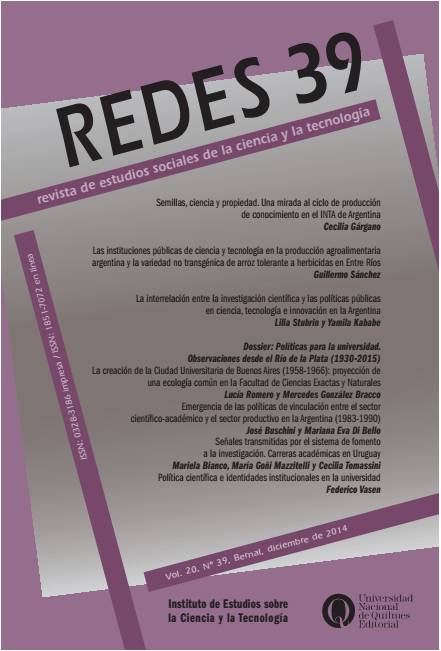
Science policy and institutional identities in a university setting.
DOI:
https://doi.org/10.48160/18517072re39.627Keywords:
university, science policy, autonomy, bureaucratization, institutional identityAbstract
Science and technology policy are usually analyzed as public policies originated in governmental agencies. There are however also initiatives to fund research and development at the institutional level in universities. Drawing on theoretical literature and a case study of Argentina’s biggest higher education institution, in this article we aim to propose three key issues for analysis for university research policies. The first relates to the place of research in the definition of the universities’ institutional identity and involves the tension between scientific and professional university. The second addresses the issue of institutional “operational freedom”, with regard both externally to its sponsor and internally to its form of internal governance. Tensions emerge in this case between autonomy, interventionism and bureaucratization. The third point deals with the social appropriation of research outcomes. The opposition here is between the new pro-commercialization academic ethos and the view of university as the place for social critique. Finally, we conclude that the analysis of research policies at the university level should consider its specific characteristics with regard to the identities at play and the distribution of power between stakeholders in the institutional governance.
References
Altbach, P. y J. Balán (2007), World Class Worldwide. Transforming Research Universities in Asia and Latin America, Baltimore, The Johns Hopkins University Press.
Arocena, R. y J. Sutz (2001a), La universidad latinoamericana del futuro. Tendencias, escenarios, alternativas, México, udual.
Arocena, R. y J. Sutz (2001b), “Changing Knowledge Production and Latin American Universities”, Research Policy, vol. 30, N° 8, pp. 1221-1234.
Austin, A. E. (1996), “Institutional and Departmental Cultures: The Relationship between Teaching and Research”, New Directions for Institutional Research, N° 90, pp. 57-66.
Baldridge, J. (1971), “Introduction: Models of University Governance: Bureaucratic, Collegial and Political”, en Baldridge, J. (ed.), Academic governance: Research on institutional politics and decision making, Berkeley, McCutchan Publishing, pp. 1-20.
Bekerman, F. (2010), “Modernización conservadora: la investigación científica durante el último gobierno militar en Argentina”, en Beigel, M. F., Autonomía y dependencia académica. Universidad e investigación científica en un circuito periférico: Chile y Argentina (1950-1980), Buenos Aires, Biblos, pp. 198-220.
Bernasconi, A. (2007), “Is There a Latin American Model of the University?”, Comparative Education Review, vol. 52, N° 1, pp. 27-52.
Blume, S. (1985), “After the darkest hour... Integrity and Engagement in the Development of University Research”, en Wittrock, B. y A. Elzinga, (eds.), The University Research System. The Public Policies of the Home of Scientists. Estocolmo, Almqvist & Wiskell International, pp. 139-166.
Buchbinder, P. (2005), Historia de las universidades argentinas, Buenos Aires, Sudamericana.
Buttel, F. (2005), “Ever since Hightower: The politics of agricultural research activism in the molecular age”, Agriculture and Human Values, vol. 22, N° 3, pp. 275-283.
Clark, B. (1995), Places of Inquiry. Research and Advanced Education in Modern Universities, Berkeley, University of California Press.
Clark, B. (1998), Creating Entrepreneurial Universities. Organizational Pathways of Transformation, Londres, Pergamon.
Dagnino, R. (2007), Ciência e tecnologia no Brasil: o processo decisório e a comunidade de pesquisa, Campinas, unicamp.
Elzinga, A. (1985), “Research, Bureaucracy and the Drift of Epistemic Criteria”, en Wittrock, B. y A. Elzinga, The University Research System. The Public Policies of the Home of Scientists, Estocolmo, Almqvist & Wiskell International, pp. 191-217.
Elzinga, A. y A. Jamison (1996), “El cambio de las agendas políticas en ciencia y tecnología”, Zona Abierta, N° 75-76, pp. 91-132.
Finocchiaro, A. (2004), uba c/ Estado Nacional. Un estudio sobre autonomía universitaria, Buenos Aires, Prometeo.
Hightower, J. (1973), Hard Tomatoes, Hard Times, Cambridge, Schenkman Publishing Company.
Houssay, B. (1989) [1929], “El porvenir de las ciencias en la Argentina”, en Barrios Medina, A. y A. Paladini (comps.), Escritos y discursos del Dr. Bernardo A. Houssay, Buenos Aires, Eudeba, pp. 271-294.
Hurtado, D. (2010), La ciencia argentina. Un proyecto inconcluso (1930-2000), Buenos Aires, Edhasa.
Marginson, S y M. Considine (2000), The Enterprise University. Power, Governance and Reinvention in Australia, Cambridge, Cambridge University Press.
Mollis, M. (comp.) (2003), Las universidades en América Latina: ¿reformadas o alteradas? La cosmética del poder financiero, Buenos Aires, clacso.
Morgan, K. J. (2011), “Where is von Humboldt’s University Now?”, Research in Higher Education - Daigaku Ronsho, N° 42, pp. 325-344.
Myers, J. (1992), “Antecedentes de la conformación del complejo científico y tecnológico, 1850-1958”, en Oteiza, E. (dir.), La política de investigación científica y tecnológica en Argentina. Historia y perspectivas, Buenos Aires, Centro Editor de América Latina, pp. 87-114.
Naidorf, J. (2009), Los cambios en la cultura académica de la universidad pública, Buenos Aires, Eudeba.
Naishtat, F. y M. Toer (eds.) (2005), Democracia y representación en la universidad. El caso de la Universidad de Buenos Aires visto por sus protagonistas, Buenos Aires, Eudeba.
Nicolau, J. C. (2003), Ciencia y técnica en Buenos Aires (1800-1860), Buenos Aires, Eudeba.
OEI (2012), Ciencia, tecnología, sociedad e innovación para el desarrollo y la cohesión social, Madrid, oei.
Prego, C. y O. Vallejos (2010), La construcción de la ciencia académica, Buenos Aires, Biblos.
Rip, A. (2008), “Towards Post-Modern Universities”, conferencia dictada en la prime-Latin America Conference, Mexico, 24-26 de septiembre. Disponible en <https://www.utwente.nl/bms/steps/research/colloquia_ and_seminars/colloquia/bestanden/rip/>.
Rovelli, L. (2005), “La cuestión ‘local’ en la etapa fundacional de las nuevas universidades del conurbano bonaerense. Los casos de la Universidad Nacional de Quilmes y General Sarmiento”, comunicación presentada a la III Jornada de Jóvenes Investigadores del Instituto Gino Germani, Buenos Aires, 29-30 de septiembre.
Slaughter, S. y L. Leslie (1997), Academic Capitalism. Poltics, Policy and the Entrepreneurial University, Baltimore, The Johns Hopkins University Press.
Torstendahl, R. (1993), “The transformation of professional education in the nineteenth century”, en Rothblatt, S. y B. Wittrock, (eds.), The European and American University since 1800. Historical and sociological essays, Cambridge, Cambridge University Press, pp. 109-141.
Tünnermann Bernheim, C. (2008), Noventa años de la Reforma Universitaria de Córdoba (1918-2008), Buenos Aires, clacso.
Unzué, M. (2012), “Historia del origen de la Universidad de Buenos Aires a propósito de su 190 aniversario”, Revista Iberoamericana de Educación Superior, vol. 3, N° 8, pp. 72-88.
Vasen, F. (2013), “La construcción de una política científica institucional en la uba (1986-1994)”, tesis de doctorado, Bernal, Universidad Nacional de Quilmes.
Versino, M. (2000), “Las incubadoras universitarias de empresas en la Argentina: reflexiones a partir de algunas experiencias recientes”, Redes, vol. 7, N° 15, pp. 141-181.
Fuentes:
Acta del Consejo Superior de la Universidad de Buenos Aires N° 10/86, 27 de agosto de 1986.
Downloads
Published
How to Cite
Issue
Section
License
Copyright (c) 2014 Redes. Journal of Social Studies of Science and TechnologyThe documents published here are governed by the licensing criteria
Creative Commons Argentina.Atribución - No Comercial - Sin Obra Derivada 2.5 https://creativecommons.org/licenses/by-nc-nd/2.5/ar/