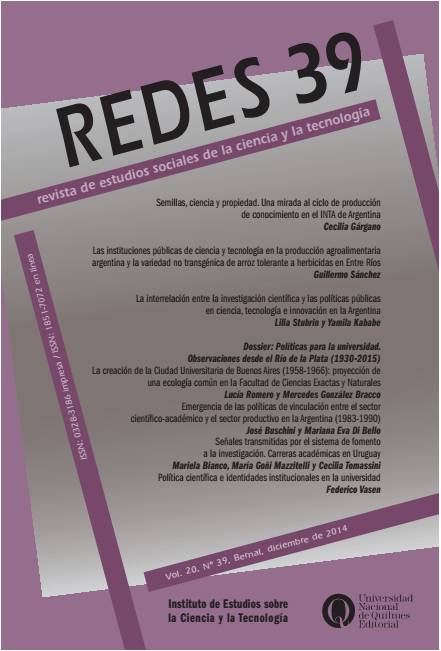
Signals emitted by the research support system: tensions at the orientation of knowledge production and academic careers in Uruguay.
DOI:
https://doi.org/10.48160/18517072re39.626Keywords:
academic evaluation, academic careers, knowledge production, university, uruguayAbstract
The aim of this paper is to analyze how current changes in the Uruguayan research reward’s system biases the orientation of academic careers and the kind of knowledge produced. We propose to visualize evaluation criteria as signals that influence and create tensions in researchers’ everyday decisions. First, a brief review is made regarding the major changes at the institutional context for promotion of academic careers and knowledge generation in Uruguay. Second, we analyze perceptions from researchers at different knowledge fields regarding the effects of current academic evaluation mechanisms at two interrelated levels: knowledge production and academic careers. In the field of knowledge production, contradictions between “production of quality” and “quantum of production” are expressed, as well as the coexistence of incentives to promote innovation and productivity-based assessment criteria. Regarding the orientation of academic careers, a dilemma emerges regarding the time devoted to different activities involved in their development. Finally, the main results are summarized and relevant questions for future research are suggested.
References
ANII (2013), “Indicadores de Ciencia, Tecnología e Innovación Uruguay 2013”, Montevideo, anii.
ASCB (American Society for Cell Biology) (2012), “San Francisco Declaration on Research Assessment (dora)”, San Francisco, American Society for Cell Biology. Disponible en <http://www.ascb.org/dora/>.
Ardanche, M. (2013), “Modelos para armar. Ciencia, tecnología e innovación en clave de transversalidad”, tesis de Licenciatura en Ciencia Política, Montevideo, Facultad de Ciencias Sociales, Universidad de la República.
Bach, J.-F. y D. Jérome (coords.) (2011), “Du bon usage de la bibliométrie pour l’évaluation individuelle des chercheurs”, París, Académie des Sciences. Disponible en <http://www.academie-sciences.fr/pdf/rapport/ avis170111.pdf>.
Bianchi, C. y M. Snoeck (2009), “Ciencia, tecnología e innovación en Uruguay: desafíos estratégicos, objetivos de políticas e instrumentos, propuestas para el pencti 2010-2030”, Montevideo, anii.
Bianchi, C. y M. Bianco (2014), “Value attributed of the sti policies in Uruguay. 2005-2011”, en Crespi, G. y G. Dutrénit (eds.), sti Policies for Development: the Latin American Experience, Cham, Springer, pp. 133-156.
Butler, L. (2003), “Modifying publication practices in response to funding formulas”, Research Evaluation, vol. 12, N° 1, pp. 39-46.
Chubin, D. (1990), “Scientific practice and the contemporary politics of knowledge”, en Cozzens, S. y T. Gieryn (eds.), Theories of science in society, Bloomington, Indiana University Press, pp. 144-163.
Cole, J. y S. Cole (1973), Social stratification in science, Chicago, University of Chicago Press.
Elder, G. (1998), “The Life Course as Developmental Theory”, Child Development, vol. 69, N° 1, pp. 1-12.
Etzkowitz, H. (1998), “The norms of entrepreneurial science: cognitive effects of the new university-industry linkages”, Research Policy, vol. 27, N° 8, pp. 823-833.
Etzkowitz, H. y L. Leydesdorff (2000), “The dynamics of innovation: from national systems and ‘Mode 2’ to a triple helix of university-industry-government relations”, Research Policy, vol. 29, N° 2, pp. 109-123.
Gibbons, M. et al. (1997), La nueva producción del conocimiento: la dinámica de la ciencia y la investigación en las sociedades contemporáneas, Barcelona, Pomares/Corredor.
Goñi Mazzitelli, M. (2013), “Agendas de investigación en el sur: desafíos y dificultades para construir caminos propios. La experiencia de la Universidad de la República, Uruguay”, en Calderón Acero, C. et al., Bienes comunes. Espacio, conocimiento y propiedad intelectual, Buenos Aires, Clacso, pp. 203-240.
Hemlin, S. y S. Barlebo Rasmussen (2006), “The Shift in Academic Quality Control”, Science, Technology, & Human Values, vol. 31, N° 2, pp. 173-198.
Hessels, L., H. van Lente y R. Smits (2009), “In search of relevance: The changing contract between science and society”, Science and Public Policy, vol. 36, N° 5, pp. 387-401.
Kreimer, P. (2012), “La evaluación de la actividad científica: desde la indagación sociológica a la burocratización. Dilemas actuales”, ponencia presentada en las IX Jornadas Latinoamericanas esocite, México, del 5 al 8 de junio.
Lam, A. (2011), “What motivates academic scientists to engage in research commercialization: ‘Gold’, ‘ribbon’ or ‘puzzle’?”, Research Policy, vol. 40, N° 10, pp. 1354-1368.
Merton, R. (1973), The sociology of science, Chicago, University of Chicago Press.
Neufeld, J. y M. von Ins (2011), “Informed peer review and uninformed bibliometrics?”, Research Evaluation, vol. 20, N° 1, pp. 31-46.
Nowotny, H., P. Scott y M. Gibbons (2001), Re-Thinking Science: Knowledge and the Public in an Age of Uncertainty, Nueva York, Wiley.
Sahel, J. (2011), “Quality versus quantity: assessing individual research performance”, Science Translational Medicine, vol. 3, N° 84. Disponible en <http://stm.sciencemag.org/content/3/84/84cm13.full>.
Schwartzman, S. (2009), “A Pesquisa Científica e o Interesse Público”, Revista Brasileira de Inovação, vol. 1, N° 2, pp. 361-395.
Sutz, J., N. Gras y M. Bianco (2015), “La evaluación académica: ¿instrumento universal, herramienta para el desarrollo?”, ponencia presentada en el III Foro Bienal Iberoamericano de Estudios del Desarrollo, Montevideo.
Tien, F. y R. Blackburn (1996), “Faculty Rank System, Research Motivation, and Faculty research Productivity: Measure Refinement and Theory Testing”, The Journal of Higher Education, vol. 67, N° 1, pp. 2-22.
Tomassini, C. (2013), Ciencia académica y género. Trayectorias académicas de varones y mujeres en dos disciplinas del conocimiento dentro de la Universidad de la República, Montevideo, csic/Udelar.
Udelar (2012), “Balance y perspectiva de algunas políticas de impulso a la investigación en la Universidad 2007-2011”, Montevideo, Universidad de la República, col. Hacia la Reforma Universitaria N° 13.
Vaccarezza, L. y J. P. Zabala (2002), La construcción de la utilidad social de la ciencia. Investigadores en biotecnología frente al mercado, Bernal, Editorial de la Universidad Nacional de Quilmes.
Van Dalen, H. y K. Henkens (2012), “Intended and unintended consequences of a Publish or Perish Culture: a worldwide survey”, Journal of the American Society for Information Science and Technology, vol. 63, N° 7, pp. 1282-1293.
Weber, M. (1919), “El político y el científico”, documento digital preparado por el Programa de Redes Informáticas y Productivas de la Universidad Nacional de General San Martín. Disponible en <http://www.hacer.org/ pdf/WEBER.pdf>.
Ziman, J. (2000), Real Science: What it Is and What it Means, Cambridge, Cambridge University Press.
Zuckerman, H. y R. Merton (1971), “Patterns of evaluation in science: Institutionalisation, structure and functions of the referee system”, Minerva, vol. 9, N° 1, pp. 66-100.
Zuckerman, H. (1973) [1972], “Age, Aging and Age Structure in Science”, en Merton, R., The sociology of science, Chicago, University of Chicago Press, pp. 497-560.
Downloads
Published
How to Cite
Issue
Section
License
Copyright (c) 2014 Redes. Journal of Social Studies of Science and TechnologyThe documents published here are governed by the licensing criteria
Creative Commons Argentina.Atribución - No Comercial - Sin Obra Derivada 2.5 https://creativecommons.org/licenses/by-nc-nd/2.5/ar/