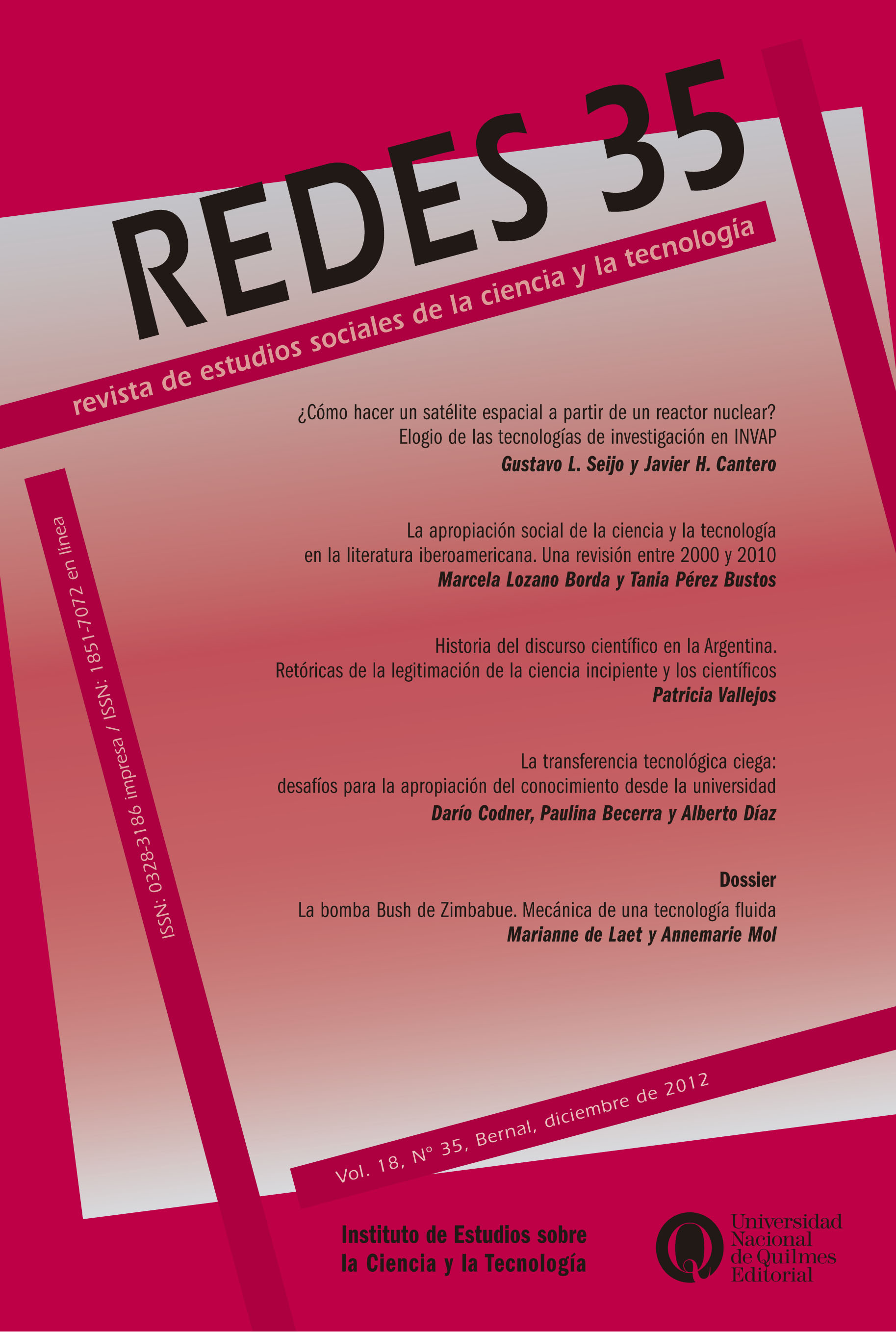
The Zimbabwe Bush pump: mechanics of a fluid technology
DOI:
https://doi.org/10.48160/18517072re35.620Keywords:
agency, appropiate technology, design, heric actorship, modesty, normativity, water pumpsAbstract
In this paper we investigate the intricacies of an admirable water pumping device – the Zimbabwe Bush Pump ‘B’ type – so as to find out what makes it an “appropriate technology”. This turns out to be what we call the “fluidity” of the pump (of its boundaries, or of its working order, and of its maker). We find that in travelling to intractable places an object that isn’t
too rigorously bounded, that doesn’t impose itself but tries to serve, that is adaptable, flexible and responsive –in short, a fluid object– may well prove to be stronger than one which is firm. By analysing the success and failure of this device, its agency and the way in which it shapes new configurations in the Zimbabwean socio-technical landscape, we partake in the current
move in science and technology studies to transform what it means to be an actor. And by mobilizing the term “love” for articulating our relation to the Bush Pump, we try to contribute to shaping novel ways of ‘doing’ normativity
References
Akrich, M. (1989), “La construction d’un système socio-technique. Esquisse pour une anthropologie des techniques”, Anthropologie et Sociétés, 13, (2), pp. 31-54.
Akrich, M. (1992), “The de-scription of technical objects”, en Bijker, W. y J. Law (eds.), Shaping Technology/Building Society, Cambridge, The mit Press, pp. 205-224.
Akrich, M. (1994), “Essay of techno-sociology: a gasogene in Costa Rica”, en Lemonnier, P. (ed.), Technological Choices, Londres y Nueva York, Routledge, pp. 298-337.
Appadurai, A. (ed.) (1986), The social life of things, Cambridge, Cambridge University Press.
Arnoldi, M-J., C. Geary y K. Hardin (eds.) (1996), African material culture, Bloomington, Indiana University Press.
Auster, P. (1988), The invention of solitude, Nueva York, Penguin (en español: La invención de la soledad, Barcelona, Edhasa, 1990).
Auster, P. (1997), Hand to mouth: A chronicle of early failure, Londres, Faber & Faber (en español: A salto de mata: crónica de un fracaso precoz, Barcelona, Anagrama, 1998).
Berg, M. (1997), Rationalizing medical work, Cambridge, The mit Press.
Bhabha, H. (ed.) (1990), Nation and narration, Nueva York, Routledge (en español: Nación y narración. Entre la ilusión de la identidad y las diferencias culturales, Buenos Aires, Siglo XXI Editores, 2010).
Biggs, S., C. Edwards y J. Griffiths (1978), Irrigation in Bangladesh, Brighton, ids-university of Sussex.
Bijker, W. y J. Law (1987), “General introduction”, en Bijker, W., T. Hughes y T. Pinch (eds.) (1987), The social construction of technological systems: new directions in the sociology and history of technology, Cambridge, The mit Press, pp. 1-14.
Bijker, W., T. Hughes y T. Pinch (eds.) (1987), The social construction of technological systems: new directions in the sociology and history of technology, Cambridge, The mit Press.
Boltanski, L. (1990), L’amour et la justice comme compétences: trois essais de sociologie de l’action, París, Métailié(en español: El amor y la justicia como competencias: tres ensayos de sociología de la acción, Buenos Aires, Amorrortu, 2000).
Bowker, G. C. y S. Leigh Star (1999), Sorting things out: classification and its consequences, Cambridge, The mit Press.
Callon, M. (1980), “Struggles and negotiations to define what is problematic and what is not: the socio-logics of translation”, en Knorr, K., R. Krohn y R. Whitley (eds.), The social process of scientific investigation, Dordrecht, Reidel, pp. 197–220 (en español: “Luchas y negociaciones para definir qué es y qué no es problemático. La socio-lógica de la Traducción”, Redes, 12, (23), 2006, pp.105-128).
Callon, M. (1986a), “Some elements of a sociology of translation: domestication of the scallops and the fishermen of St. Brieuc Bay”, en Law, J. (ed.), Power, action, and belief: a new sociology of knowledge?, Londres, Routledge & Kegan Paul, pp.196-233 (en español: “Algunos elementos para una sociología de la traducción: La domesticación de vieyras y los pescadores de la bahía de Saint Brieuc”, en Iranzo, J. M. et al. (comps.), Sociología de la ciencia y la tecnología, Madrid, Consejo Superior de Investigaciones Científicas, 1995).
Callon, M. (1986b), “The sociology of an actor-network: the case of the electric vehicle”, en Callon, M., J. Law y A. Rip (eds.), Mapping the dynamics of science and technology, Basingstoke, Macmillan, pp. 19-34.
Callon, M. (1999), “Actor network theory. The market test”, en Law, J. y J. Hassard (eds.), Actor-network theory and after, Oxford, Blackwell, pp. 181–195.
Collier, J. H. (1998), The nature of metascientific claims, Tesis doctoral, Department of Science and Technology Studies, Virginia Tech.
David, P. (1993), “Intellectual property institutions and the panda’s thumb”, en Wallerstein, M. B., M. E. Mogee y R. A. Schoen (eds.), Global dimensions of intellectual property rights in science and technology, Washington, National Academy Press, pp. 19–61.
Davidson, B. (1979), Africa in history, Londres, Paladin.
De Laet, M. (1998), “Intricacies of technology transfer: travel as mode and method”, Knowledge and Society, 11, pp. 213-234.
Ellul, J. (1987), Le bluff technologique, Paris, Hachette.
Erpf, K. (s/f ), The Bush pump. The national standard handpump of Zimbabwe, htn Case Study, Schweizersische Kontaktstelle für Angepasste Technologie-Handpump Technology Network skat-htn, St. Gallen. Disponible en <http://www.watersanitationhygiene.org/References/EH_KEY_ REFERENCES/WATER/Handpumps/Handpump%20Specific%20 Types/Bush%20Pump%20%28HTN%20SKAT%29.pdf>, consultado el 27/09/2011.
Fleck, L. (1980) [1935], Entsehung und Entwicklung einer wissenchftlichen Tatsache, Frankfurt, Suhrkamp (en español: La génesis y el desarrollo de un hecho científico, Madrid, Alianza, 1986).
Fraenkel, P. (1986), “Water lifting devices”, FAO Irrigation and drainage paper, (43).
Gomart, E. y A. Hennion (1999), “A sociology of attachment: music amateurs, drug users”, en Law, J. y J. Hassard (eds.), Actor-network theory and after, Oxford, Blackwell, pp. 220-247.
Gordon, A. y D. Gordon (eds.) (1996), Understanding contemporary Africa, 2ª edición, Boulder, Lynne Rienner Publishers.
Habermas, J. (1968), Technik und Wissenschaft als Ideologie, Frankfurt, Suhrkamp (en español: Ciencia y técnica como ideología, Madrid, Tecnos, 1984).
Haraway, D. (1991), Simians, cyborgs, and women, Nueva York, Routledge (en español: Ciencia, cyborgs y mujeres, Madrid, Cátedra, 1995).
Harro, M. y P. P. Mollinga (1994), “Water bij de uien”, Kennis en methode, xviii, (1), pp. 40-63.
Institute of Development Studies – University of Sussex (ids) (1980), “Who gets the last rural resource? The potential and challenge of lift irrigation for rural poor”, ids Discussion Paper, (156).
Kamrava, M. (1993), Politics and society in the third world, Londres, Routledge.
Kroes, P. y A. Meijers (eds.) (2001), The empirical turn in the philosophy of technology, Oxford, Elsevier.
Latour, B. (1988), The pasteurization of France, Cambridge, Harvard University Press.
Latour, B. (1993), Aramis, ou l’amour des techniques, París, La Découverte.
Law, J. (1987), “Technology and heterogeneous engineering: the case of portuguese expansion”, en Bijker, W., T. Hughes y T. Pinch (eds.), The social construction of technological systems: new directions in the sociology and history of technology, Cambridge, The mit Press, pp. 111-134.
Law, J. (1994), Organizing modernity, Oxford, Blackwell.
Law, J. (1998), “Machinic pleasures and interpellations”, en Brenna, B., J. Law e I. Moser (eds.), Machines, agency and desire, Oslo, tmv, pp. 23-45.
Law, J. (2002a), “Hidden heterogeneities: complexities, formalism and aircraft design”, en Law, J. y A. Mol (eds.), Complexities. Social studies of knowledge practices, Durham, Duke University Press, pp. 116-141.
Law, J. (2002b), Aircraft stories: decentering the object in technoscience, Durham, Duke University Press.
Law, J.Law, J. y A. Mol (1998), “On metrics and fluids: notes on otherness”, en Chia, R. (ed.), Organized worlds, Londres, Routledge, pp. 20–38.
Lemonnier, P. (ed.) (1994), Technological choices, Londres y Nueva York, Routledge.
Lynch, M. (1993), Scientific practice and ordinary action: ethnomethodology and social studies of science, Cambridge, Cambridge University Press.
Merges, R. (1992), Patent law and policy, Charlottesville, Michie.
Mol, A. y J. Law (2004), “Regions, networks and fluids: anaemia and social topology”, Social Studies of Science, 24, (4), pp. 641-671.
Mol, A. y J. Mesman (1996), “Neonatal food and the politics of theory: some questions of method”, Social Studies of Science, 26, (2), pp. 419-444.
Morgan, P. (1990), Rural water supplies and sanitation, Londres, McMillan.
Morgan, P. (1994), The Zimbabwe Bush pump: a manual for the installation, dismantling and Maintenance of the “B” type Bush pump, Harare, Mvuramanzi Trust / V&W Engineering.
Morgan, P. (1995), “Zimbabwe’s user-friendly Bush pump”, Waterlines, 14, (2), pp. 23–26.
Morgan, P. (1997), “Small steps count – building on traditional methods for rural water supply”, Waterlines, 15, (3), pp. 2–5.
Morgan, P. y E. Von Elling (1994), Bucket pump manual for fieldworkers, Harare, Blair Research Laboratory-Ministerio de Salud de Zimbabue.
Morgan, P. et al. (1996), “Now in my backyard. Zimbabwe’s upgraded family well programme”, Waterlines, 14, (4), pp. 8-11.
Peters, J. S. (1997), “The bank, the press, and the return of ‘nature’: of currency, credit, and literary property in the 1690s”, en Brewer, J. y S. Staves (eds.), Early modern conceptions of property, Londres, Routledge, pp. 365-388.
Pickering, A. (ed.) (1992), Science as practice and culture, Chicago, The University of Chicago Press.
Potter, J. y M. Wetherell (1987), Discourse and social psychology: beyond attitudes and behaviour, Londres, Sage.
Reynolds, T. y S. Cutcliffe (1997), Technology and the west, Chicago, The University of Chicago Press.
Robertson, G. et al. (eds.) (1994), Travellers’ tales: narratives of home and displacement, Londres, Routledge.
Rose, M. (1993), Authors and owners: the invention of copyright, Cambridge, Harvard University Press.
Rosenthal, L. (1997), “(Re)writing Lear: literary property and dramatic authorship”, en Brewer, J. y S. Staves (eds.), Early modern conceptions of property, Londres, Routledge, pp. 323-338.
Ruddick, S. (1984), “Maternal thinking”, en Trebilcot, J. (ed.), Mothering: essays in feminist theory, Totowa, Rowman & Allanheld, pp. 213–230.
Serres, M. (1980), Hermès V: le passage du nord-ouest, París, Minuit (en español: El paso del noroeste: Hermes V, Madrid, Debate, 1981).
Staudenmaier, J. (1989), Technology’s storytellers: reweaving the human fabric, Cambridge, The mit Press.
Strathern, M. (1992), After nature: english kindship in the twentieth century, Cambridge, Cambridge University Press.
Unicef (1998), Unicef information papers on groundwater, .
Uvin, P. (1996), “Scaling up the grassroots and scaling down the summit: the relations between third world ngos and the un”, en Weiss, T. y L. Gordenker (eds.), NGO, the UN, and global governance, Boulder, Lynne Rienner Publishers, pp. 159-176.
V&W Engineering, (1988), Instructions for drilling tubewells with the Vonder Rig, Harare, Blair Research Laboratory.
Werbner, R. y T. Ranger (eds.) (1996), Postcolonial identities in Africa, Londres, Zed Books.
Downloads
Published
How to Cite
Issue
Section
License
Copyright (c) 2012 Redes. Journal of Social Studies of Science and TechnologyThe documents published here are governed by the licensing criteria
Creative Commons Argentina.Atribución - No Comercial - Sin Obra Derivada 2.5 https://creativecommons.org/licenses/by-nc-nd/2.5/ar/